In the 2026 Indian market, investing in a Kornit DTG printer means preparing a budget ranging from ₹1.2 Crore to ₹4.5 Crore (approx. $150,000 to $550,000 USD) or even higher. This is more than just the price of a machine; it is your “entry ticket” into the high-end custom apparel market.
Faced with such a significant capital expenditure (CAPEX), are you worried about a long payback period? Or are you concerned that exorbitant original ink costs will lock you out of your own profit margins?
As a leading global inkjet solution expert, Winnerjet understands your hesitation. With nearly 20 years of experience serving digital textile printing clients worldwide, we are here to pull back the curtain on the Kornit India price landscape. We will analyze the “hidden costs” that salespeople won’t tell you and provide a consumable optimization strategy that maintains Kornit’s top-tier quality while drastically slashing your operating expenses (OPEX).
I. Why is Kornit Pricing So High in the Indian Market?
Before you call a distributor for a quote, we need to deconstruct Kornit’s “premium logic.” This helps you determine if it fits your business scale and reveals the true value behind the investment.
1. Patent-Protected Pre-treatment-Free Technology
The most striking difference between Kornit and other brands is the NeoPigment™ core technology, which enables a “Wet-on-Wet” process.
The Pain Point: Traditional DTG (using Epson or Chinese printheads) requires separate pre-treatment spraying and drying before printing. In the hot and humid climates of Surat or Ludhiana, controlling the drying speed and uniformity of pre-treatment liquid is extremely difficult, often leading to defects.
The Kornit Solution: Pre-treatment is integrated and sprayed at the moment of printing. You don’t need extra heat presses or pre-treatment machines, which simplifies your production line and saves the labor cost of at least 2–3 workers.
2. Stunning Industrial Output: How Many Units Per Hour?
If you are chasing scalable profitability, speed is your lifeline. Kornit machines are engineered for 24/7 continuous operation:
Top-Tier Productivity (Atlas MAX): At full capacity, it can output 125 – 150 dark garments per hour.
The Workhorse (Storm HD6): A single operator can achieve a stable output of 55 – 85 units per hour.
Comparison: Compared to modified desktop printers that only manage 10–15 units per hour, one Kornit acts as a miniature “print array.” For Indian exporters facing seasonal order surges, this high throughput allows you to accept urgent “fast fashion” orders, directly boosting your market competitiveness.
3. Hardware: Industrial Printhead Durability
Kornit utilizes expensive, high-performance Dimatix Spectra Polaris or Ricoh industrial-grade recirculating printheads.
These heads support high-frequency jetting and feature an internal ink recirculation system. This technology significantly reduces the risk of clogging—a common issue with pigment sedimentation in India—extending the printhead lifespan to 3–5 years, whereas standard heads might need replacement every 6 months.
4. Unavoidable “Hard Costs”: Import Duties & GST
This is the primary reason why prices in India are much higher than the global average.
Customs Duty: Since Kornit equipment is manufactured in Israel, imports to India are subject to 10% – 15% Basic Customs Duty (BCD) plus other surcharges.
GST Pressure: As capital goods, you must pay 18% GST. While this can be claimed as an Input Tax Credit (ITC) later, it poses a massive challenge to your initial cash flow.
II. 2026 Kornit DTG Printer Price in India: Where is the Entry Barrier?
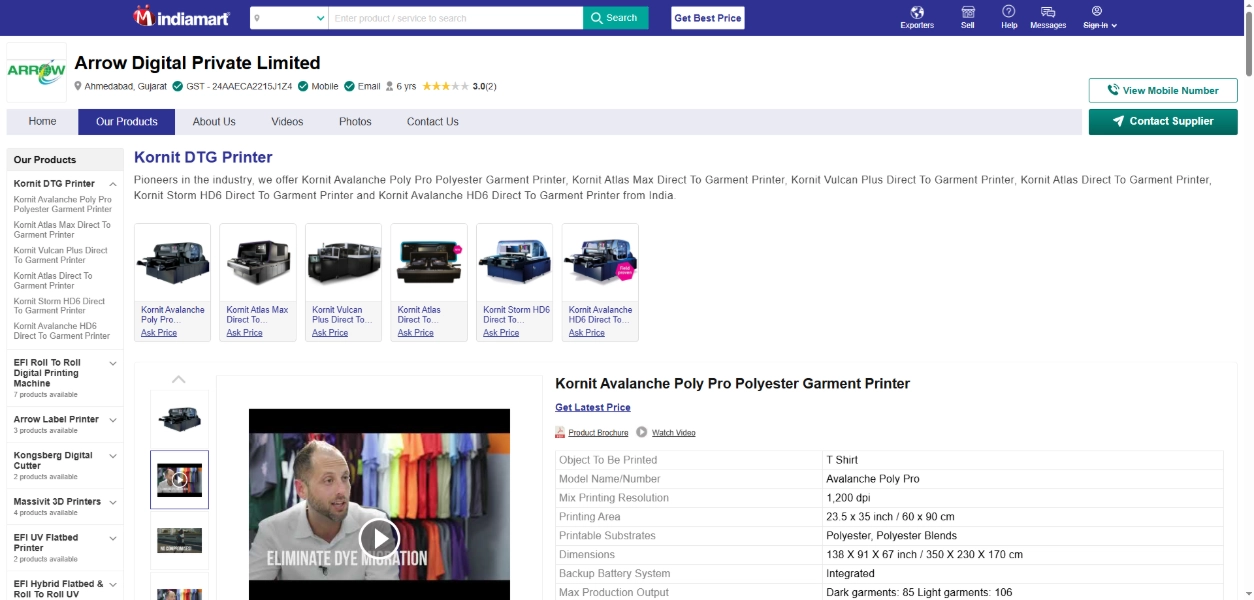
When inquiring about Kornit prices in India, you’ll notice that distributors (such as those on IndiaMart) rarely list prices publicly. This is because machine configuration, exchange rate fluctuations, and Service Level Agreements (SLA) all impact the final deal.
Based on Winnerjet’s 2026 market research, here are the estimated price benchmarks for the Indian market:
| Core Model | Positioning & Capacity | Price (INR) | Price (USD) |
|---|---|---|---|
| Kornit Atlas MAX | Industrial Production (130-150 units/hr) | ₹2.8 Cr - ₹3.5 Cr | $330,000 - $420,000 |
| Kornit Storm HD6 | Mid-to-Large Factory (55-85 units/hr) | ₹1.4 Cr - ₹1.8 Cr | $165,000 - $215,000 |
| Kornit Presto S | Roll-to-Roll Fabric (Waterless) | ₹3.8 Cr - ₹5.0 Cr | $450,000 - $600,000 |
| Kornit Breeze | E-commerce & Sampling (25-35 units/hr) | ₹45 Lakhs - ₹65 Lakhs | $55,000 - $78,000 |
For most small-to-medium enterprises (SMEs) in India, standard Chinese-made or Epson-modified DTG printers cost between ₹10 Lakhs and ₹25 Lakhs. In contrast, Kornit’s entry price is 5–10 times higher.
III. Beyond the Machine: Where Else is Your Money Going?
Many Indian entrepreneurs realize only after signing the contract that buying the Kornit is just the beginning of an expensive journey. This is known as the Total Cost of Ownership (TCO). In our 20 years of serving the Indian market, we’ve seen too many factories struggle because they ignored these “Hidden Costs”:
1. The Impact of Ink Consumables
Kornit’s business model is similar to “razors and blades.” The machine is expensive, but the real recurring expense is the proprietary ink.
High Unit Price: Sourcing through authorized local distributors like Arrow Digital or DCC Group, original ink prices usually range from ₹18,000 to ₹28,000 per liter.
Staggering Annual Spend: If you run a mid-sized factory in Tirupur producing 1,000 T-shirts a day, your monthly ink bill could easily reach ₹6 Lakhs – ₹10 Lakhs. In 2–3 years, your ink expenditure could equal the price of a new machine. This closed-loop system is the primary “black hole” for your profits.
2. “The Greenhouse Guest”: Strict Environmental Control
A Kornit is not a machine you can just drop into a standard warehouse. It has rigorous requirements for air quality, temperature, and humidity.
Electricity Bill Killers: You must equip the facility with industrial HVAC and humidification. During the 45°C heatwaves in Delhi or Aligarh, maintaining a constant 18°C–30°C and 45%–60% humidity will cause your power bills to skyrocket.
Downtime Risk: If the environment is off-spec, ink viscosity changes, leading to clogs or color shifts. In areas with frequent power outages, you will also need a high-end industrial UPS (Uninterruptible Power Supply).
3. “High Salary, Hard to Find”: Specialized Labor Costs
Don’t expect a general operator to master a multi-million-rupee piece of equipment.
Wage Premium: Operating a Kornit requires an understanding of RIP software and complex color management. In hubs like Bangalore or Mumbai, a certified Kornit operator’s salary is typically 40% – 60% higher than a standard printer operator.
Training Cycles: Even for experienced staff, specialized training takes weeks. The time cost and the risk of staff turnover are pressures you must calculate into your overhead.
4. Localized Maintenance Fees (SLA)
In India, if a machine goes down, waiting for parts to be shipped from overseas is disastrous.
Maintenance Contracts: While distributors like Arrow Digital provide local service, Annual Maintenance Contracts (AMC) after the warranty period are expensive, typically costing 5%–10% of the machine’s original price.
IV. How to Optimize Kornit Production Costs?
After communicating with thousands of textile firms in Ahmedabad, Delhi, and Mumbai, Winnerjet’s expert team found that many factories struggle with thin margins despite owning top-tier equipment.
The reason is simple: Over-reliance on a single, closed-loop OEM solution. To help you break free, we recommend these strategic optimizations:
1. Consumable Flexibility: Introducing Winnerjet High-Viscosity DTG Ink
Kornit’s recirculation system demands specific physical ink properties (viscosity, surface tension, conductivity).
Cost-Effective Alternative: In the post-warranty phase, switching to Winnerjet’s high-viscosity recirculating pigment ink can slash your consumable spend by 30% – 50%.
Color Matching: Our lab tests show Winnerjet ink achieves over 96% color gamut match compared to the original. For standard Indian cotton T-shirt printing, end-customers can rarely see any difference.
Printhead Protection: We understand the cost of a Spectra head. Winnerjet uses exclusive nano-grade triple filtration technology (particle size <100nm) to ensure perfect compatibility with Kornit’s filtration systems—no clogs, no damage.
2. The “Hybrid Fleet” Strategy
Savvy Indian business owners don’t use a Kornit for every single order.
Offload Non-Core Orders: Using a Kornit for low-margin promotional items (like election shirts or giveaways) is “using a sledgehammer to crack a nut.” We recommend supplementing your factory with 1–2 high-spec Epson i3200-based machines.
Reduce Wear and Tear: Save the Kornit for high-end brand orders to utilize its 150 units/hr power, while diverting small, basic jobs to smaller machines. This extends the lifespan of your expensive Kornit printheads.
3. Winnerjet Support: From OEM to Custom Supply
With 20 years of history, Winnerjet is not just an ink vendor—we are your R&D center.
Global OEM/ODM Services: For large Indian distributors or printing franchises, we offer Professional OEM Services. We can customize ink formulas based on your specific regional environment (e.g., humidity variations in North vs. South India) and provide private labeling.
Supply Chain Security: We understand Indian Customs complexity. Winnerjet has a mature logistics pipeline to India, ensuring your production line never stops due to “ink-out” situations.
Why Choose Winnerjet as Your Partner?
At Winnerjet.com, we believe an expensive machine should not be a “profit shackle.”
20 Years of Expertise: We’ve witnessed every tech iteration from Epson modifications to Kornit industrial giants.
Rigorous Quality Control: Every batch sent to India undergoes an 8-step inspection to ensure stability even in 40°C Indian heat.
Professional Consulting: We don’t just sell ink; we provide cost-analysis reports to help you calculate the exact ROI for every T-shirt.
V. Conclusion: Should You Buy a Kornit?
If you have stable orders from international brands (Nike, Adidas, Zara) and require extreme daily output, investing in a Kornit Atlas MAX is the best way to build a competitive moat.
If you are an SME T-shirt customizer, we suggest starting with high-value DTG solutions paired with Winnerjet high-quality inks to manage your initial financial risk.
Ready to get a customized cost-reduction plan for your Kornit operation?
[Contact the Winnerjet Expert Team Today] to request a Free Ink Sample Pack and a detailed Cost-Benefit Analysis. Let’s get your Indian printing business ahead of the curve!