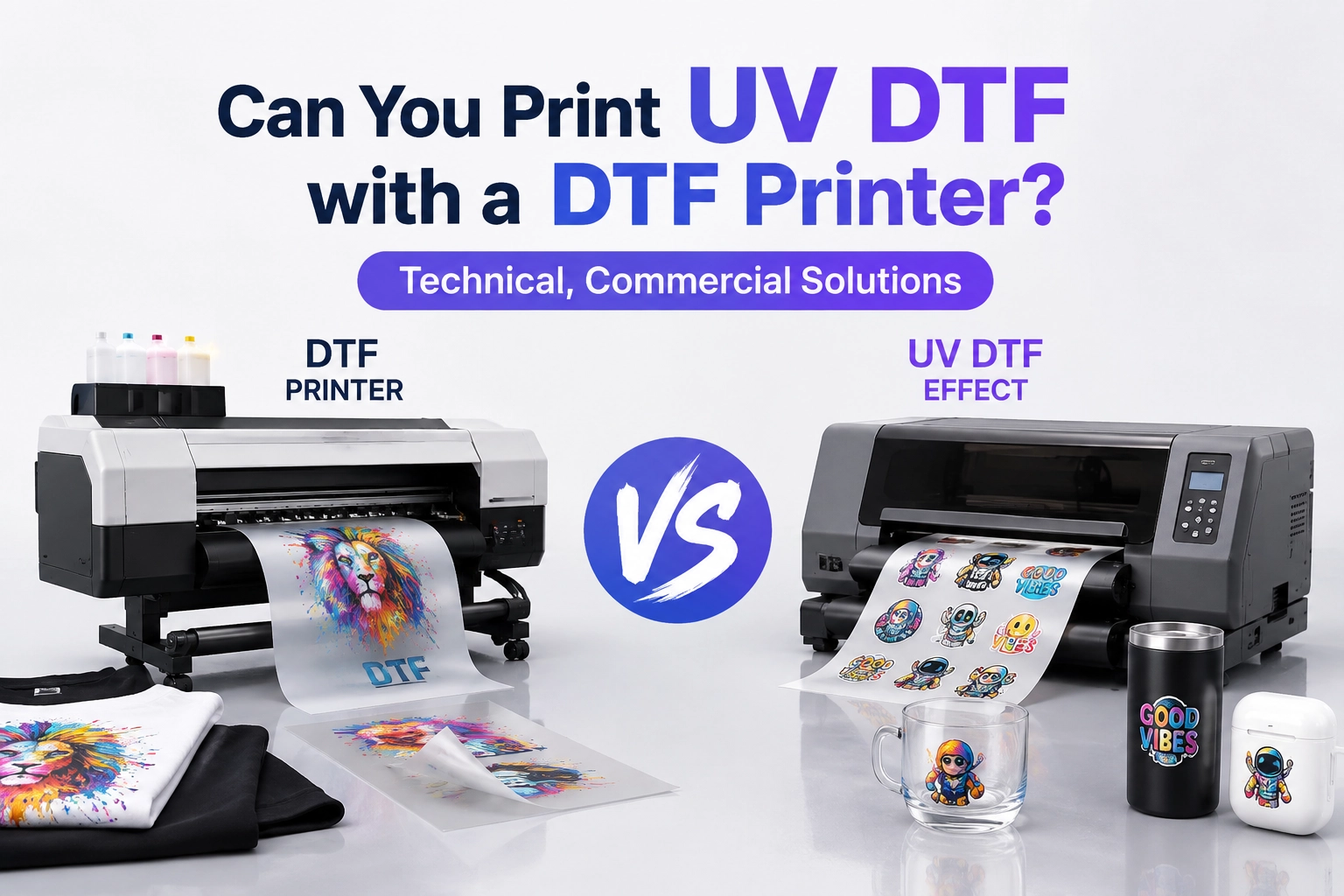
No, you cannot print UV DTF directly with a standard DTF printer. As widely discussed in community forums where users frequently express confusion about equipment interchangeability—such as this thread on Reddit’s r/DTFTransferTalk—attempting to swap these workflows will result in printhead destruction and severe hardware corrosion. Standard DTF relies on water-based textile ink, TPU powder, and heat pressing for apparel, whereas UV DTF requires UV-curable ink, LED-UV light cross-linking, and inline AB film lamination for hard-surface stickers. As a digital printing manufacturer, Winnerjet provides dedicated DTF printing solutions and UV printing solutions to help you build a reliable, high-yield commercial setup.
Learn about DTF Printing vs UV DTF Printing
Understanding the hardware architecture and chemical foundations of direct-to-film technologies is essential for avoiding catastrophic equipment damage and maintaining high production yields.
Printer Types and Hardware Architecture
- DTF Printers: Engineered for textile transfers, standard DTF systems feature built-in front/rear heating plates to keep water-based inks stable, an automated TPU powder shaker to coat the wet ink layer evenly, and a high-temperature conveyor oven to melt the hot-melt powder into a durable adhesive backing.
- UV DTF Printers: Designed for rigid transfers, UV DTF systems integrate high-intensity LED-UV lamps directly beside the printhead carriage for instantaneous photo-curing. They are equipped with solvent-resistant, anti-corrosive ink supply lines (dampers, tubing, and capping stations) and an integrated heated inline laminator that automatically seals the printed A-film with the transfer B-film under precise pressure.
DTF Printing vs UV DTF Printing: Key Specifications
| Technical Dimension | Standard DTF System | Industrial UV DTF System |
|---|---|---|
| Ink Type | Water-based textile pigment ink (CMYK + White) | UV-curable ink (CMYK + White + Gloss/Varnish) |
| Curing Mechanism | Thermal evaporation + TPU powder heat fusion | LED-UV light instant photo-polymerization |
| Print Media | Single-layer PET release film | Specialized A-film (adhesive base) + B-film (transfer film) |
| Primary Application | Flexible apparel & fabrics (cotton, polyester, blends) | Rigid & irregular substrates (glass, metal, acrylic, wood) |
| Winnerjet Solution | Winnerjet DTF Printer & DTF Ink | Winnerjet UV DTF Printer & UV DTF Ink |
What Happens If You Put UV Ink in a DTF Printer?
In commercial production environments, attempting to print UV DTF using a standard DTF printer is technically impossible and economically disastrous. While it might seem tempting to swap inks to expand product offerings, forcing UV-curable ink into a system designed for water-based textile pigments will result in severe equipment destruction.
Rapid Corrosion of the Ink Delivery System
UV ink contains aggressive photo-initiators, reactive monomers, and specialized solvents. When introduced into a standard DTF printer, these chemical components rapidly dissolve, warp, and harden the water-based ink tubing, dampers, capping stations, wiper blades, and peristaltic pumps, leading to massive ink leaks and total delivery failure.
Permanent Printhead Clogging and Electrical Burnout
Standard DTF printers lack the high-intensity LED-UV curing lamps required to solidify UV ink instantly. Without UV light, liquid ink floods the release film and pool inside the carriage station. The uncured, sticky liquid easily wicks back into the printhead surface and driver board, triggering catastrophic electrical shorts and permanently destroying the printhead.
Missing Gloss Channels and Automated Lamination
Premium UV DTF transfers (crystal labels) rely on a three-layer print process: White ink, CMYK color, and a protective Gloss/Varnish finish, followed immediately by hot-roll lamination to bond the A-film to the B-film. Standard DTF printers lack dedicated varnish ink channels and integrated laminating mechanisms, making it impossible to produce durable, scratch-resistant transfers.
Why Modifying a DTF Printer for UV DTF Printing Is Not Feasible
Attempting to modify a standard DTF printer or swap inks to produce UV DTF transfers is a high-risk venture for commercial print shop operations. Non-factory modifications lead to extreme hardware failure rates and immediately void equipment warranties. More critically, frequent printhead clogs and fluid system corrosion cause persistent production downtime, resulting in costly order delays that far outweigh the initial savings on hardware.
The most efficient path to reliable, high-yield manufacturing is investing in dedicated equipment engineered for your specific product applications.
Scenario-Based Equipment Solutions
To achieve optimal color accuracy, transfer adhesion, and wash durability, hardware and consumable configurations should be paired directly with your production goals:
- Apparel & Textile Production
- Target Substrates: T-shirts, hoodies, canvas bags, caps, and various cotton, polyester, or blend fabrics.
- Recommended Solution: Deploy a dedicated DTF Printer paired with high-opacity Winnerjet DTF Ink and premium TPU hot-melt powder. This combination ensures vibrant color saturation, bright white underbases, high stretchability, and excellent wash durability. Explore the complete Winnerjet DTF Printing Solution.
- Rigid Packaging & Merchandise Labeling
- Target Substrates: Glassware, tumblers, acrylic awards, metal containers, electronic casings, and irregular hard surfaces (peel-and-stick crystal labels).
- Recommended Solution: Deploy a specialized UV DTF Printer featuring LED-UV lamps and integrated inline lamination, paired with Winnerjet UV DTF Ink with a dedicated varnish channel. This delivers high-gloss, scratch-resistant transfers with strong tactile relief. Explore the complete Winnerjet UV Printing Solution.
As an international digital printing consumables and equipment manufacturer, Winnerjet provides print shops with end-to-end hardware, formulation, and technical services:
- Factory-Direct Pricing & OEM Customization: Access competitive wholesale factory pricing and tailor-made OEM ink formulations designed to lower unit production costs.
- One-Stop Technical Support: Our application engineers help evaluate your target output, volume targets, and performance metrics to pair your shop with the ideal machinery and consumable setup.
To request equipment specification sheets, sample test kits, or factory quotes, Contact Us directly to
Conclusion & Technical Consultation
Using dedicated, purpose-built machinery is the only reliable way to guarantee color accuracy, long-term transfer adhesion, and optimal printhead longevity in commercial digital printing. Attempting to mix hardware workflows creates unnecessary operational risks and costly downtime.
Whether you need high-volume apparel transfers or premium rigid packaging labels, matching your production goals with verified equipment is key to maximizing profit margins. Contact Winnerjet today with your target application and daily capacity requirements—our application engineers will help you select the ideal printer, ink, and media configuration for your shop.
Frequently Asked Questions
Can you use UV DTF film (A/B film) in a standard DTF printer?
No. Standard DTF printers rely on liquid water-based ink that receives TPU hot-melt powder before entering a heat-curing oven. UV DTF A-film already comes pre-coated with a pressure-sensitive adhesive layer. Passing UV DTF film through a standard DTF printer will cause the adhesive layer to degrade under heat, while TPU powder will fail to bond correctly to the film, resulting in ruined media and printhead jams.
Can a regular inkjet printer be converted into a UV DTF printer?
While DIY hobbyists sometimes modify desktop inkjet printers with aftermarket UV lamps and custom ink lines, it is strictly unviable for commercial production. Converted machines suffer from high failure rates, uncalibrated UV light exposure, frequent printhead short-circuits, and lack an integrated inline laminator for B-film pressure rolling. The frequent downtime and wasted media quickly surpass the cost of purchasing a purpose-built commercial UV DTF printer.
What is the durability difference between DTF and UV DTF transfers?
DTF Transfers: Engineered for flexible textiles, offering exceptional wash durability, stretchability, and fabric flexibility. They withstand dozens of high-temperature laundry cycles without cracking or peeling.
UV DTF Transfers: Engineered for hard, non-porous substrates. They offer superior scratch resistance, waterproofing, chemical resistance, and outdoor UV light stability, but are not suitable for washable, flexible apparel.
Do UV DTF transfers require a heat press machine?
No. Unlike standard DTF transfers that require a heat press to melt the TPU powder into fabric fibers, UV DTF transfers function as high-durability “crystal stickers.” Once the image is printed and laminated with B-film, you simply peel off the base film, press the transfer firmly onto a hard surface with your fingers or a squeegee, and peel off the transfer film.
Can you print standard DTF transfers using a UV DTF printer?
No. UV DTF printers use UV-curable inks that solidify into a rigid or semi-rigid polymer film when exposed to LED-UV light. Applying a UV-cured transfer onto flexible fabric will result in a heavy, plastic-like texture that cracks immediately when stretched or washed. Additionally, UV ink cannot properly bond with heat-melt TPU powder.