Choose the Epson XP-15000 if you prioritize superior color gamut (ideal for portraits and fine art), need rear-feed support for heavy cardstock (up to 300gsm+), or plan to use high-yield third-party inks and DTF/sublimation conversions.
Choose the Canon iP8720 if you can source a budget-friendly legacy or refurbished unit and need an all-around A3+ printer that balances everyday document printing with standard photo output.
Winnerjet strongly recommends the Epson XP-15000 for long-term reliability and commercial flexibility. Its MicroPiezo cold-firing printhead technology offers exceptional durability when paired with custom, compatible ink formulations, making it the ideal workstation for both fine art photography and digital transfer printing (DTF/Sublimation).
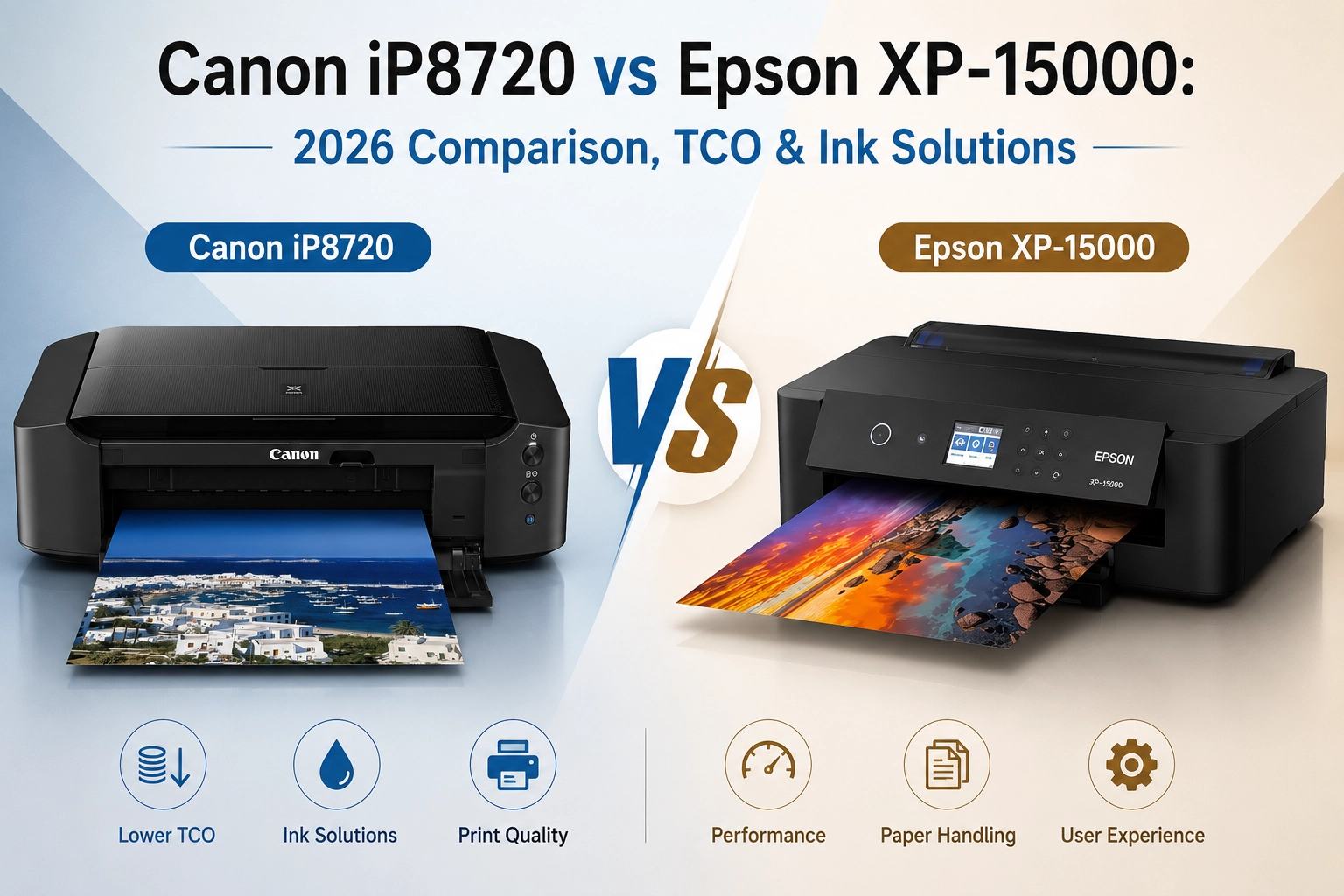
Epson XP-15000 vs Canon iP8720: 2026 Market Status and Comparison
1. Specifications Comparison Table
| Feature | Canon PIXMA iP8720 | Epson Expression Photo HD XP-15000 |
|---|---|---|
| Printhead Technology | Thermal Inkjet | MicroPiezo Cold-Firing |
| Ink Configuration | 6-Color Hybrid: Pigment Black (PGBK) + 5 Dye Inks (C/M/Y/GY/BK) | 6-Color Claria HD: Proprietary Red + Gray + C/M/Y/BK |
| Feed Paper Trays | Single Top Rear Feed Tray | Bottom Main Tray + Rear Specialty Paper Feed Slot |
| Max Paper Weight | Approx. 260 gsm (Canon Photo Paper only) | 300+ gsm (Heavy Fine Art Paper, Cardstock & Transfer Film) |
| 2026 Market Status | Discontinued / Secondary Market & NOS Only | Active in Retail / Mature Conversion Ecosystem |
2. 2026 Market Reality Check
Canon PIXMA iP8720: The Discontinued Legacy & Sourcing Risks
By 2026, the Canon iP8720 has been officially listed as discontinued across primary retail sales channels. Units circulating on the market today fall into two main categories: New Old Stock (NOS) with heavily inflated prices, or refurbished/second-hand machines with unpredictable hardware histories. Purchasing this model in 2026 carries distinct risks:
Thermal printheads are wearable components. With official production halted, genuine Canon printhead replacements have become scarce and cost-prohibitive.
Used units frequently suffer from thermal degradation in nozzle micro-elements or saturated waste ink pads, leading to high failure rates after purchase.
The machine’s hardware thermal nature resists continuous ink supply systems (CISS) and thick specialty pigment formulations, making it unsuitable for commercial production setups.
Epson Expression Photo HD XP-15000: The Active Workhorse for Specialty Conversion
In contrast to Canon’s legacy status, the Epson XP-15000 remains actively manufactured, widely available, and heavily supported in 2026. Beyond its reputation for high-end photography output, it has established a dominant ecosystem in the micro-commercial apparel printing market:
Thanks to its MicroPiezo cold-firing printhead, the XP-15000 effortlessly handles thick textile inks and white ink formulations, making it the top choice for desktop Direct-to-Film (DTF) and dye-sublimation conversions.
The machine benefits from a mature network of chipless refillable cartridges, CISS setups, reset utilities, and tailored transfer inks, making daily operational and running costs extremely manageable.
Photo Quality, Media & Printhead Technology
1. Color Performance & Ink Architecture
Epson 6-Color Claria HD: Integrates dedicated Red and Gray inks. Red expands warm-tone color gamut for natural skin tones and sunset gradients; Gray secures neutral balance for cast-free black-and-white photos with subtle shadow details.
Canon 6-Color Hybrid System: Uses Pigment Black (PGBK) with 5 Dye inks. Pigment black produces razor-sharp office text on plain paper; the 5-dye set handles standard photos well but offers lower ceiling in deep shadows and rich warm spectra.
2. Printhead Technology (Core Differentiator)
Canon iP8720 (Thermal Inkjet): Uses heat pulses to eject ink, making nozzles prone to thermal wear. Lower tolerance for non-OEM formulations; continuous use of third-party or heavy inks accelerates clog risks and element degradation.
Epson XP-15000 (MicroPiezo Cold-Firing): Utilizes physical mechanical pressure without heat, providing long printhead lifespan and high durability. Highly adaptable to various compatible inks (Dye, Pigment, DTF white ink, Sublimation).
3. Media & Heavy Stock Handling
Epson XP-15000: Features a Rear Specialty Paper Feed Slot with a straight paper path, effortlessly passing 300gsm+ heavy cardstock, fine art paper, and transfer films without scraping or jamming.
Canon iP8720: Relies on a single top rear tray with a curved paper path, leading to roller slippage or feed errors when loading rigid media exceeding 300gsm.
Running Costs & Third-Party Ink
1. OEM Cartridge Cost Calculation (OEM Cost per Print)
A4 Full-Bleed Photos: Running OEM cartridges on either model yields an average ink cost of $1.20 – $1.80 per print.
A3+ (13×19″) Full-Bleed Photos: Due to coverage scale, original ink costs jump to $3.50 – $5.00 per print (Epson OEM Claria HD cartridges have lower yields, making high-volume runs particularly expensive).
2. Third-Party Ink & Refillable System Experience (Third-Party & Refillable Options)
Printhead Durability Comparison:
Epson MicroPiezo Cold-Firing Head: Operates mechanically without heat, offering structural resilience. It seamlessly accepts premium dye inks, archival pigment inks, as well as high-viscosity DTF inks and sublimation inks without clogging or thermal strain.
Canon Thermal Inkjet Head: Relies on extreme heat pulses. Non-OEM ink formulations can suffer chemical breakdown or sediment buildup under high heat, accelerating nozzle degradation and irreparable clogs.
Refillable Cartridges & CISS Recommendations:
Slash TCO by 90%: Transitioning to refillable cartridge systems or Continuous Ink Supply Systems (CISS) with bulk bottle inks reduces the A3+ photo ink cost down to $0.20 – $0.40 per print.
Operational Advice: The Epson XP-15000 is the clear winner for continuous bulk refill systems. For the Canon iP8720, stick to high-grade pre-filled compatible cartridges rather than heavy CISS setups. Have questions about ink compatibility? Feel free to contact us for factory-direct guidance.
Why is the XP-15000 the top choice for DTF and sublimation conversions?
1. Technical Feasibility Analysis
The Epson Expression Photo HD XP-15000 has become the premier choice for desktop Direct-to-Film (DTF) and dye-sublimation conversions due to its specialized hardware engineering:
DTF white ink contains dense titanium dioxide pigment, which is thermally sensitive. The XP-15000’s cold-firing mechanism generates no heat during ejection, preventing white ink from coagulating inside the nozzles and drastically reducing clog risks.
DTF PET films are relatively rigid with sensitive coatings. The rear specialty feed slot provides a flat pathway, preventing film curvature, paper jams, or printhead strikes.
The XP-15000 benefits from widely available chipless software solutions and waste ink reset utilities, making continuous bulk ink integration seamless for daily production.
2. Specialty Consumables Selection Standards
Converting the hardware is only half the formula; transfer quality and wash durability rely entirely on premium consumable matching:
White inks must feature optimal rheology and anti-settling dispersion to maintain consistent viscosity. Color inks require high color intensity to prevent banding or misdirected spraying.
DTF Hot Melt Powder: Select uniform, high-purity TPU powders. Superior powders offer a soft hand-feel, excellent elasticity, and leave no residue or edge powder after curing.
DTF PET Transfer Film: Opt for anti-static, easy-peel (hot or cold peel) double-sided matte PET films. High ink-absorption coatings prevent ink bleeding, feathering, or pooling on heavy passes.
Recommendation on Final Purchase Decision
Buy the Canon PIXMA iP8720 if:
You can source a well-maintained second-hand unit or New Old Stock (NOS) machine at a steep discount.
Your workflow focuses on standard office document printing (benefiting from its pigment black ink) and basic A3+ photo output without requiring specialty non-OEM inks.
Buy the Epson Expression Photo HD XP-15000 if:
You require superior photo fidelity, extended warm color gamuts, and true monochromatic gray balance via dedicated Red and Gray inks.
You regularly print on 300gsm+ heavy cardstock, cotton fine art paper, or transfer films using its rear specialty feed.
You plan to lower running costs with third-party dye inks or pigment inks, or intend to convert the printer for DTF or Dye-Sublimation production.
FAQ – Epson XP-15000 vs Canon iP8720
Is the Canon iP8720 discontinued?
Yes, the Canon PIXMA iP8720 has been officially listed as discontinued across primary retail sales channels. Current units available on the market are primarily New Old Stock (NOS) with inflated price tags or used/refurbished models. Purchasing legacy units in 2026 carries distinct risks due to a scarcity of official replacement printheads.
Can I use the Epson XP-15000 for DTF or sublimation printing?
Yes, the Epson XP-15000 is one of the most popular desktop printers for Direct-to-Film (DTF) and dye-sublimation conversions. Its MicroPiezo cold-firing printhead handles dense textile and white ink formulations reliably, while mature chipless firmware allows for seamless CISS (Continuous Ink Supply System) integration.
Which printer is better for black and white photography?
The Epson Expression Photo HD XP-15000 is superior. Thanks to its dedicated Gray ink in the 6-color Claria HD set, it delivers neutral gray balance without unwanted color casts (such as greenish or purplish tints) and yields smoother shadow transitions. The Canon iP8720 includes a gray ink as well, but its hybrid color mapping falls slightly short in monochromatic dynamic range.
Can the Canon iP8720 be converted for DTF printing?
No, it is highly unrecommended. The Canon iP8720 utilizes a Thermal Inkjet printhead that relies on intense heat pulses during ink ejection. The titanium dioxide in DTF white ink coagulates rapidly under heat, leading to irreversible clogging and printhead burnout. DTF conversions strictly require cold-firing MicroPiezo technology like Epson’s.
How can I lower the total cost of ownership (TCO) for the Epson XP-15000?
By replacing OEM cartridges with refillable cartridge systems or a CISS setup using factory-direct bulk bottled inks (dye, pigment, or DTF inks), you can drop the A3+ full-bleed photo ink cost from $3.50–$5.00 down to $0.20–$0.40 per print, slashing daily operational costs by over 90%.