Choose UV Hard Ink (Rigid) for flat, non-bending surfaces like acrylic, metal, glass, and wood where maximum scratch resistance (5H–6H) is essential. Choose UV Soft Ink (Flexible) for bendable or stretchable media like TPU phone cases, genuine leather, and roll-up banners to prevent cracking. For print shops handling a 50/50 mix on a single printer, UV Neutral Ink offers the most balanced compromise without frequent ink line flushing.
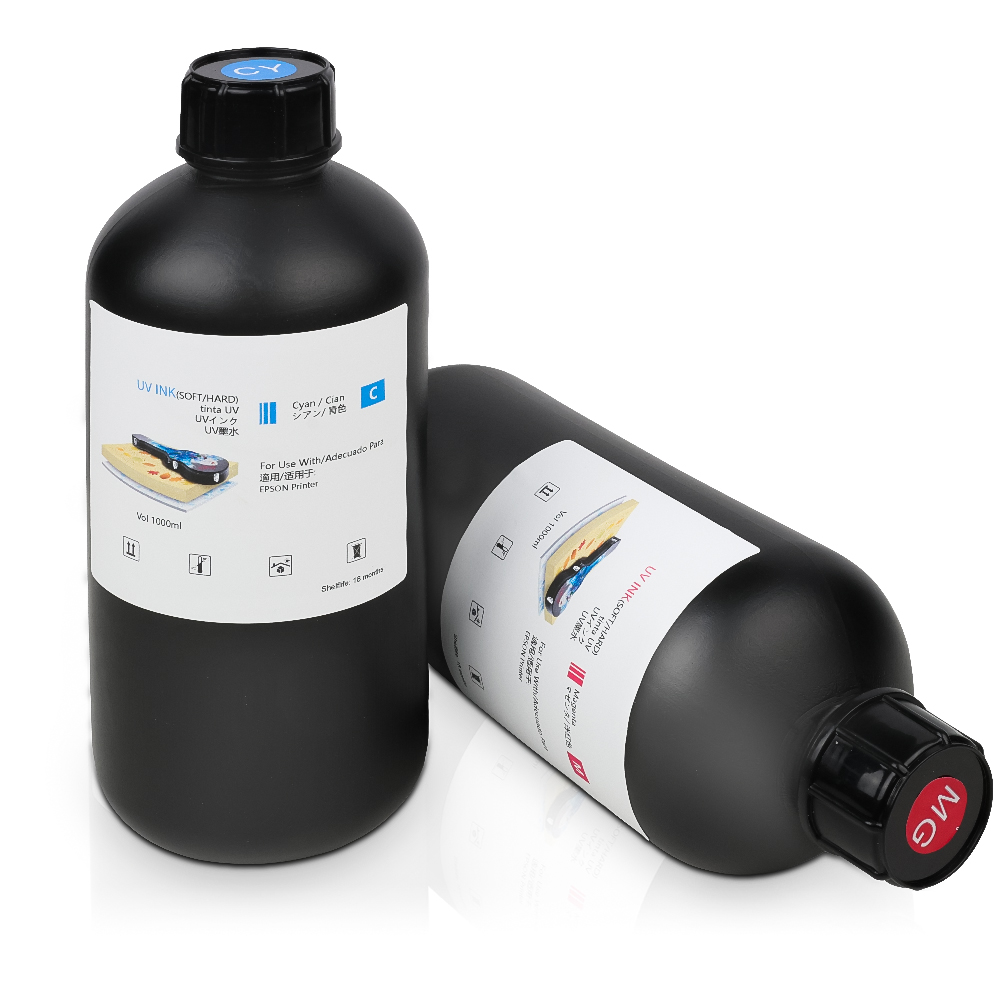
1. What Is UV soft Ink?
UV soft Ink is a UV-curable ink formulated with high elasticity and excellent adhesion. After curing, the ink film remains soft and can be bent, stretched, or folded without cracking.
Key Features:
High flexibility and elasticity
Excellent adhesion on flexible and curved surfaces
Resistant to cracking during stretching or bending
Designed for roll-to-roll printing and soft materials
Benefits:
✔ Bendable without cracking
✔ Ideal for flexible substrates
✔ Suitable for heat pressing, bending, and forming processes
2. What Is UV hard Ink?
UV hard Ink is formulated for hard, non-flexible surfaces. After curing, the ink film becomes hard, durable, and scratch-resistant, offering sharp print details and high gloss.
Key Features:
High hardness (up to 6H or more after curing)
Sharp, vivid colors with smooth finish
Excellent abrasion and impact resistance
Designed specifically for rigid substrates
Benefits:
✔ Excellent scratch resistance
✔ Long-term durability
✔ High-quality finish and clear detail
3. What Is UV Neutral Ink?
Switching between hard and soft ink requires tedious ink flushing that wastes time and risks damaging printheads. To solve this, UV Neutral Ink was developed.
Designed for small-to-medium print shops running a single UV printer, it balances moderate flexibility (60%–70% elasticity) with dependable surface hardness.
Key Characteristics:
High Versatility: Perfect for mixed jobs like PVC foam boards, KT boards, ABS plastics, and standard promo items.
No Need to Flush: Eliminates the hassle of frequent ink changeovers.
The Limits: Not quite as scratch-resistant as hard ink on glass or metal, and not quite as flexible as soft ink on genuine leather.
If your daily orders are a balanced 50/50 mix of rigid boards and semi-flexible gifts, UV Neutral Ink is your most cost-effective solution.
4. Common Applications of UV soft Ink
UV soft Ink is ideal for substrates that require flexibility, elasticity, bending, stretching, or rolling during or after printing.
| Application | Suitability |
|---|---|
| TPU phone cases | ✓ Excellent |
| Flexible labels and stickers | ✓ Excellent |
| Leather products (bags, shoes) | ✓ Excellent |
| Soft film and banner materials | ✓ Highly recommended |
| Roll-up banners and retractable displays | ✓ Perfect match |
5. Common Applications of UV hard Ink
UV Rigid Ink is best for thick, durable, and non-flexible surfaces that will not expand or bend after printing.
| Application | Suitability |
|---|---|
| Acrylic sheets and display boards | ✓ Excellent |
| Metals (aluminum, stainless steel) | ✓ Excellent |
| Glass, ceramics, and gift products | ✓ Excellent |
| Wood, MDF, and furniture boards | ✓ Highly recommended |
| Electronics panels and industrial signs | ✓ Perfect match |
6. UV Ink Durability, Price Differences
In everyday printing and production, the durability of UV ink—a core issue—directly impacts the quality of the finished product.
| Comparison Metric | UV Soft Ink (Flexible) | UV Hard Ink (Rigid) | Real-World Bottom Line |
|---|---|---|---|
| Raw Ink Price | Standard market pricing | Identical per-bottle cost | Direct ink consumable purchase costs are virtually the same. |
| Pre-treatment Cost (Primer) | Rarely Needed Direct printing on most media |
Often Required Essential for metal, glass, tile |
Hard media requires primer wipes, raising overall job cost by ~5%–10%. |
| Scratch & Abrasion Resistance | Moderate (Flexible protective layer) | Superior (5H–6H hardness) | Hard ink is far more durable against sharp objects, friction, and daily handling. |
| Flexing & Stretch Durability | Superior (150%–200% stretch) | Poor (<10% elasticity, will crack) | Soft ink lasts years on bending substrates without micro-cracking or flaking. |
| Thermal Expansion Longevity | Expands and contracts with substrate | Prone to delamination on soft media | Soft ink survives outdoor temperature swings on vehicle wraps and tarps. |
7. How to Choose the Right Ink?
A simple rule applies:
soft material → Choose UV soft Ink
hard material → Choose UV hard Ink
If your product requires bending, wrapping, shaping, or stretching after printing, soft ink is the better option. For solid, durable products with high scratch resistance, hard ink is the ideal solution.
Why Choose Winnerjet UV Ink?
Winnerjet provides a comprehensive range of industrial-grade UV-curable ink solutions for digital inkjet printing customers worldwide. Our product portfolio covers the full spectrum of production scenarios:
Winnerjet UV Ink Series offers:
✔ Compatibility with major printheads (Epson, Ricoh, Kyocera, Konica, Seiko, etc.)
✔ Strong adhesion and outdoor durability (up to 3+ years)
✔ Vibrant color output with stable curing
✔ Low-odor, eco-friendly formulation
✔ OEM/ODM customization and sample support
With Winnerjet, you get professional stability, premium color performance, and reliable production results.
FAQ
What happens if you use hard UV ink on soft leather?
Hard ink lacks elongation elasticity. When printed on flexible leather, the rigid ink film cannot accommodate bending or stretching, quickly causing the design to micro-crack, flake off, or peel under physical stress.
Is soft ink or hard ink better for UV DTF stickers?
Neither standard ink is ideal on its own. Pure hard ink cracks on curved surfaces like mugs, while pure soft ink warps during film peeling. Use a specialized UV DTF ink formulated with balanced resilience to ensure clean peeling and crack-free curved transfers.
Can I mix UV hard and soft inks together in one printer?
Never mix them in the same ink system. They use completely different resin and photoinitiator formulations. Combining them causes resin precipitation and abrupt viscosity spikes, leading to immediate, severe printhead nozzle clogging.
Do UV hard inks and soft inks differ in price?
The raw consumable price per bottle is essentially the same. However, hard ink frequently requires a surface primer for smooth media like glass or stainless steel, which can increase overall production costs by 5% to 10%
Can I request a test sample before bulk purchase?
Absolutely — we provide sample testing to ensure the ink meets your printing needs.