Canon Lucia series inks—including sub-series such as Lucia PRO, Lucia PRO II, Lucia TD, and the classic Lucia EX—are 100% pigment ink. Formulated without any dye components, they deliver high-density color output and exceptional weather resistance for all imagePROGRAF series printers.
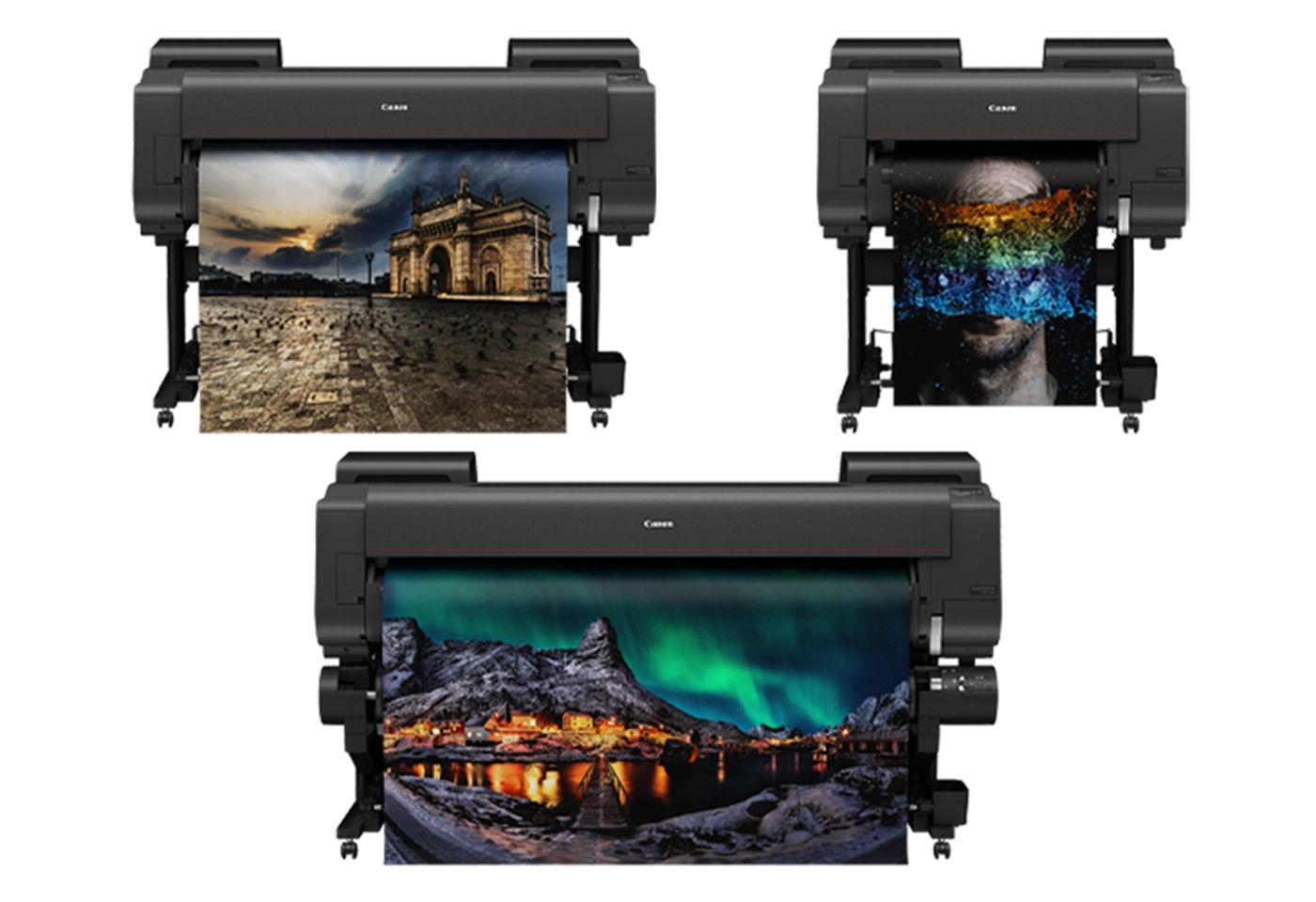
Canon Lucia Ink Characteristics
Source: Canon Europe’s Genuine LUCIA Ink Guide)
Ink Type: 100% pigment-based ink (zero dye content).
Particle Structure: Utilizes nano-scale encapsulated pigment particle suspension technology to ensure smooth jetting and uniform dispersion.
Water and Weather Resistance: Features excellent water resistance and rapid drying; prints do not easily bleed or smudge, even on uncoated plain paper (particularly with Lucia TD ink).
UV and Lightfastness: Offers outstanding UV and ozone resistance, providing museum-grade longevity against fading (lasting over 100 years).
Black Density and Gloss Optimization: Delivers exceptionally high Dmax (black density); the PRO/PRO II series features a dedicated Chroma Optimizer, effectively eliminating bronzing and uneven gloss.
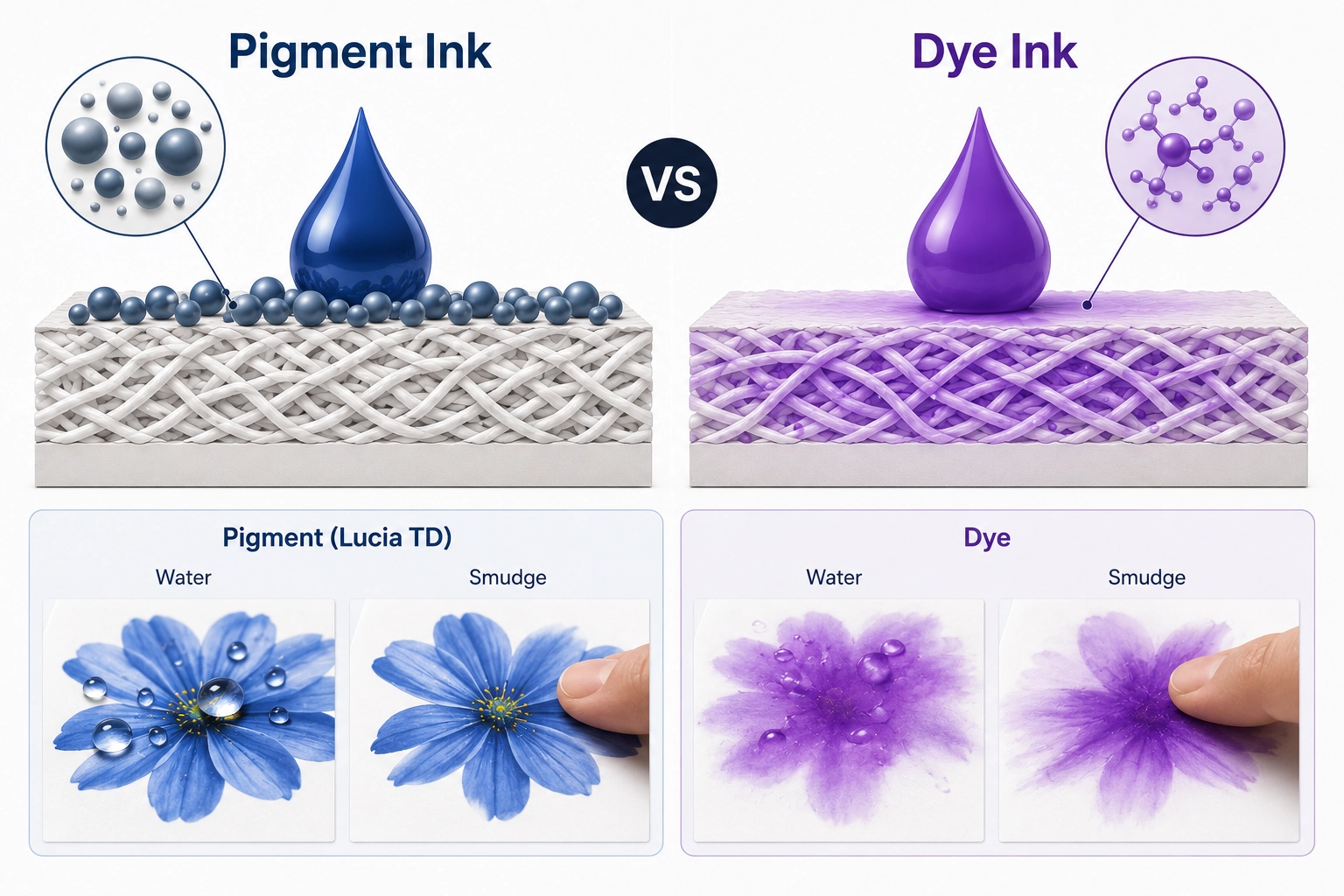
Why Canon’s Lucia ink uses a pigment-based formulation.
1. Archival Longevity & Environmental Resistance
Unlike dye inks that dissolve in water and seep deep into paper fibers, Lucia pigment inks utilize micro-encapsulated solid particles that sit precisely on the media surface. Based on years of formulation testing in our lab, this crystalline structure provides unequaled stability against ultraviolet (UV) radiation and ozone degradation. In our opinion as an ink manufacturer, this is non-negotiable for professional work: Lucia pigment prints offer museum-grade lightfastness that lasts over 100 years. Where dye inks inevitably fade within months under real-world exposure, pure pigment chemistry ensures your art and photographs preserve their true monetary and emotional value for generations.
2. High Dmax & Gloss Differential Correction
Achieving both maximum color gamut and ultra-deep black density (Dmax) on glossy media has historically been the ultimate challenge for pigment inks. Canon’s Lucia PRO and PRO II systems solve this brilliantly through high-density black formulations paired with a dedicated Chroma Optimizer. From our ink formulation perspective, we highly respect this engineering approach: the clear coat flattens the surface layer to eliminate gloss differential and metallic bronzing—the two classic flaws that plague inferior inks. When inspecting prints on gallery-grade glossy paper, this combination delivers the rich shadow detail, smooth tonal gradations, and consistent surface reflection that high-end photographers demand.
3. Lucia TD Precision & Water Resistance
Engineered specifically for technical CAD blueprints, GIS maps, and outdoor signage, Canon Lucia TD ink proves why pigment technology is superior even on budget media. By employing a high-surface-tension matte black formulation, the ink locks pigment particles onto the top fibers of uncoated plain paper instantly upon jetting. In our real-world printing tests, preventing lateral ink bleeding is what separates professional output from blurry waste. Lucia TD delivers razor-sharp vector lines, crisp fine print, and vibrant graphics that dry immediately. More importantly, its moisture-resistant pigment binder ensures that blueprints won’t smudge or bleed when exposed to rain or damp job-site handling.
Canon Lucia Ink Sub-Series & Printer Compatibility Matrix
Understanding which Canon Lucia ink sub-series matches your specific printer model is critical for achieving optimal print quality and preventing maintenance issues. As a commercial ink manufacturer, we frequently see print shops encounter jamming or head clogging simply because they used an incorrect pigment formulation for their printer’s application. Below is a structured compatibility breakdown across the main Canon Lucia sub-series:
| Lucia Sub-Series | Representative Models | Primary Applications | Core Characteristics |
|---|---|---|---|
| Lucia PRO II | PRO-1100, PRO-310, PRO-2600/4600/6600 | Fine art & gallery photography | Higher Dmax black, anti-scratch, 200-yr archival life |
| Lucia PRO | PRO-300, PRO-1000, PRO-2000/4000/6000 | Professional photo reproduction | Wide gamut, Chroma Optimizer coating for gloss uniformity |
| Lucia TD | TA-20/30, TM-200/300, TX-3000/4000 | CAD blueprints, GIS maps, POS posters | High surface-tension, fast-drying, waterproof on plain paper |
| Lucia EX | iPF6400, iPF6450, iPF8400, iPF9400 | Legacy proofing & large-format photos | Classic 12-color pigment, polymer-coated balance |
Winnerjet Note
While all Lucia sub-series use 100% pigment ink, they are not interchangeable due to differences in surface tension, resin binders, and printhead jetting frequencies. For instance, using Lucia TD ink in a fine-art PRO machine will cause bronzing on glossy papers, while running photo pigments on uncoated CAD media leads to unnecessary ink consumption.
If you are operating next-generation printers like the imagePROGRAF PRO-310, PRO-1100, or PRO-6600, ensure you use specifically formulated inks engineered for high scratch resistance. For cost-effective production without sacrificing optical density, explore our guide on compatible ink for Canon Lucia PRO II printers.
Can Canon Lucia ink be replaced with compatible Pigment ink?
This is possible, provided you select a high-quality pigment-based replacement solution.
Critical Risk Warning: The disastrous consequences of mixing dye-based inks
Chemical precipitation and clumping: Pigment inks are suspensions of solid particles, whereas dye inks are liquid solutions. Mixing the two triggers a chemical reaction that disrupts the suspension structure and forms a viscous, gel-like substance.
Thermal printhead burnout: Canon’s FINE thermal printheads are precision-engineered components. If the gel-like substance clogs the microscopic nozzles, the heating elements cannot dissipate heat; they will burn out instantly, rendering the printhead completely unusable.
Winnerjet Engineering Recommendation: Never mix dye and pigment inks. Before switching between ink types, you must flush the ink lines using a dedicated cleaning solution.
Key indicators for high-quality Lucia-compatible ink
Nanoscale particle size (<100 nm): Particles must be finely milled to below 100 nm and resin-encapsulated to prevent physical wear and nozzle clogging.
Viscosity and surface tension: Matched to OEM fluid dynamic parameters (viscosity: 2.5–4.0 mPa·s; surface tension: 30–35 mN/m) to avoid ink misting or tailing.
Suspension stability: High-efficiency dispersion technology ensures long-term stability without sedimentation, preventing sludge formation at the bottom of the cartridge during equipment downtime.
Checklist for Selecting Third-Party Pigment Inks
100% Pure Pigment Formula: Ensures zero dye content across all channels (including black and specialty colors).
Dedicated ICC Profiles: Provides specific ICC profiles for photo and fine art papers to guarantee accurate color reproduction.
Micron-Level Absolute Filtration: Utilizes a multi-stage filtration process (<0.2 microns) to protect printheads at the source.
Direct Supply & Technical Support: Offers factory-direct wholesale and OEM customization capabilities, backed by comprehensive technical support.
One-Stop Printing Solutions & Custom OEM Services
Choosing compatible ink shouldn’t put your printheads at risk. As a dedicated manufacturer of digital printing inks, consumables, and equipment, we deliver complete output ecosystems. Our deep expertise in Canon Lucia chemistry allows us to provide tailored, high-performance solutions for print service providers worldwide.
Tailored Matching: Equipment, Consumables & Tech Support
Whether you need high-density pigment ink for archival fine art or cost-effective dye ink solutions for commercial graphics, our engineering team evaluates your production requirements to match the ideal formula. We provide complete support—from equipment recommendations to custom ICC profiling and printhead maintenance guidance.
Factory-Direct Value & Custom OEM Solutions
We help printing businesses maximize profitability without compromising output quality:
- Factory Wholesale Pricing: Direct supply eliminates middleman markups, significantly lowering per-print ink costs.
- OEM/ODM Customization: Custom viscosity tuning, specialized cartridge packaging, and private label branding.
- Global Supply Stability: ISO-certified batch consistency with reliable worldwide delivery.
Ready to lower your operational costs or develop a custom ink line?
Contact us today to request free sample testing or discuss your technical requirements.