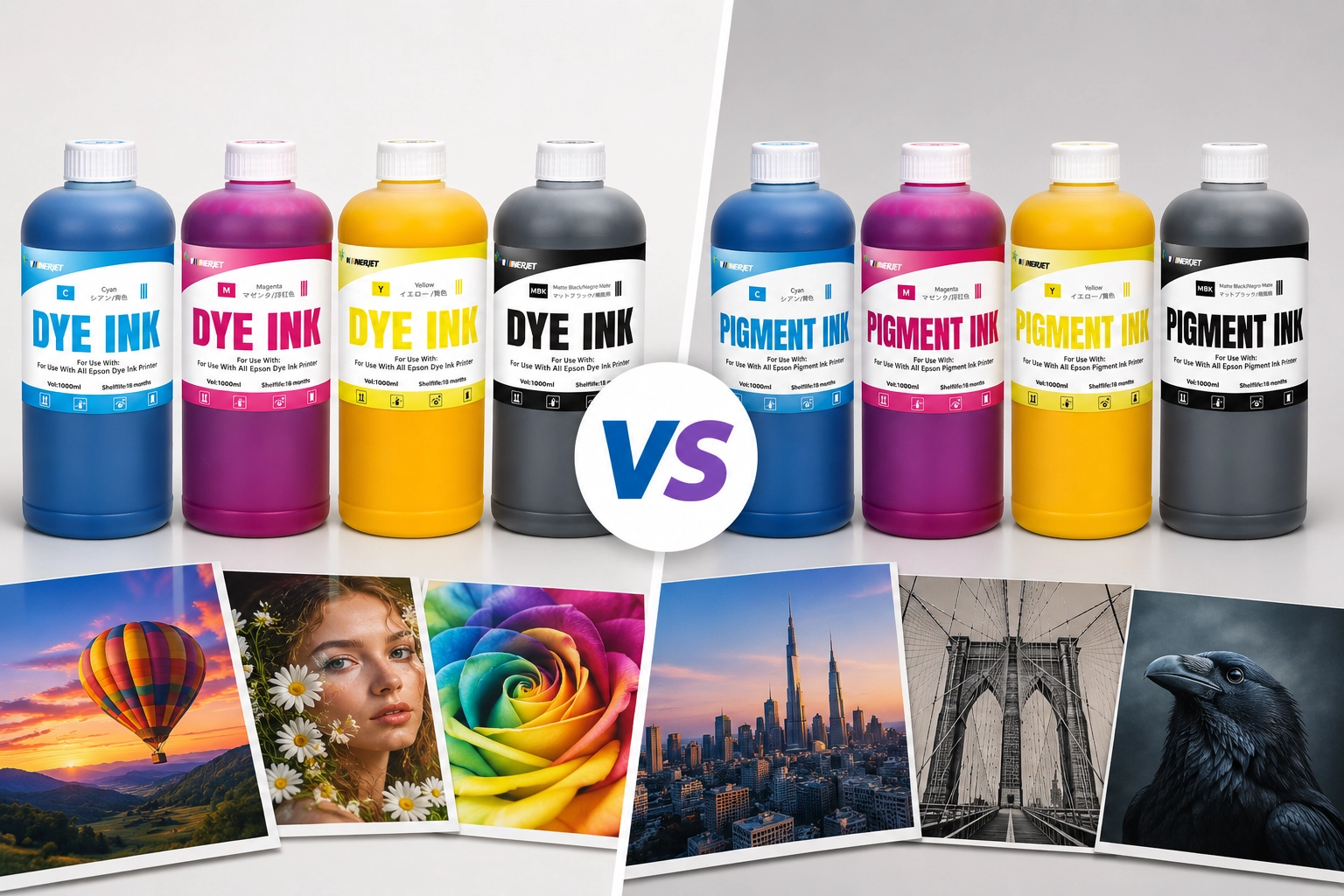
Neither is universally “better”—the choice depends entirely on your specific printing application. Dye ink is superior for vivid, high-saturation photo printing and everyday budget-friendly office use, while pigment ink is essential for waterproof, fade-resistant archival documents, outdoor signage, and specialized commercial applications.
Dye Ink vs Pigment Ink Comparison
| Feature | Dye Ink | Pigment Ink |
|---|---|---|
| Color Vibrancy | High saturation & natural smooth gradients | Matte finish with slightly lower color saturation |
| Water Resistance | Poor (water-soluble; bleeds easily when wet) | Excellent (waterproof encapsulation; no bleeding) |
| UV & Fade Resistance | Low (fades under sunlight within months) | High (archival quality; lasts decades without fading) |
| Print Head Clogging | Extremely low risk (fully dissolved molecular liquid) | Moderate risk (requires regular printer maintenance) |
| Cost & Value | Budget-friendly (lower manufacturing cost) | Higher upfront investment (specialized raw materials) |
| Main Use Case | Family photos, school projects, internal documents | Legal contracts, fine art prints, outdoor signs |
Understanding the Core Differences: Dye vs Pigment Chemistry
Understanding the core distinction between dye and pigment ink comes down to their microscopic chemistry and physical composition. Understanding how these inks interact with paper and printheads will help you select the exact formula for your equipment.
Dye-Based Ink: Chemistry & Performance
Colorants in dye-based ink are fully dissolved in liquid at a molecular level, allowing the ink droplets to absorb deeply into paper fibers upon contact. This smooth penetration delivers brilliant color saturation, seamless gradient transitions, and an exceptional high-gloss finish on coated photo media, all while keeping manufacturing costs low. However, because the ink remains water-soluble without a protective outer shell, it exhibits poor water and UV resistance, making prints prone to smudging when wet and rapid fading under direct sunlight.
Pigment-Based Ink: Chemistry & Performance
Unlike dye inks, pigment-based ink uses microscopic solid particles suspended within a liquid carrier rather than dissolving completely. During printing, the carrier evaporates, leaving these color particles to deposit on top of the substrate and lock together into a tight protective film. This physical encapsulation provides exceptional waterproofness, strong UV resistance, and anti-scratch durability, allowing archival-quality prints to last for decades without fading or running. However, because the solid particles sit on the surface and reflect light differently, pigment inks yield slightly lower color saturation and a natural matte finish rather than a high-gloss sheen.
Which type of ink is the best choice?
- Dye Ink is Best For
- Application: Everyday office documents, family photo albums, and indoor marketing flyers.
- Printers: Desktop EcoTank/CISS printers (e.g., Epson EcoTank ET-2800, Canon PIXMA G3260, HP DeskJet series) with glossy photo paper.
- Pigment Ink is Best For
- Application: Legal contracts, archival documents, museum fine art (Giclée), outdoor labels, and textile printing (DTF/DTG).
- Printers: Professional wide-format & fine art printers (e.g., Epson SureColor P700/P900, Canon imagePROGRAF PRO series, commercial DTF machinery) with matte/art paper.
Because of these distinct chemical compositions, dye and pigment inks perform very differently on paper. If you are unsure which ink type is currently loaded in your cartridges or bottles, read our step-by-step guide on how to tell if ink is dye or pigment using quick visual and water-testing methods.
Dye Ink vs Pigment Ink: Performance Breakdown and Maintenance Guide
Color Performance & Vibrancy
- Why Photo Albums & Bright Prints Prefer Dye Ink: Dye ink colorants are fully dissolved in liquid, allowing them to absorb deeply into the glossy photo paper’s emulsion layer without leaving surface residue. Light passes through and reflects evenly off the smooth surface, producing ultra-high color vibrancy, wider color gamuts, and natural tonal gradients ideal for portraits and photo printing.
Water & UV Durability
- Why Legal Contracts, Outdoor Labels & Fine Art Demand Pigment Ink: Pigment ink uses solid microscopic particles that stay on top of the substrate, bonding into a resilient layer. Once dry, this protective film provides 100% waterproofness and superior UV/fade resistance, ensuring archival documents and museum-grade fine art (Giclée prints) remain intact for decades without running or fading under ambient light.
Paper & Media Compatibility
- Media Performance: Dye ink requires coated glossy photo paper to prevent lateral bleeding along fibers; on untreated plain paper, it appears dull and blurred. Pigment ink stays on the surface, making it highly compatible with plain copy paper, matte cardstock, fine art cotton rag, and synthetic labels, yielding sharp black text without bleed-through.
Printhead Maintenance & Clogging Risks
Does pigment ink clog printheads more frequently? This is one of the most widely debated topics across active printing communities like the printers forum on Reddit. Because pigment ink consists of microscopic solid particles suspended in a liquid carrier, it carries a slightly higher risk of drying and settling inside nozzle channels if the printer sits idle for long periods compared to water-soluble dye inks.
- Essential Maintenance Protocols:
- Weekly Test Print: Run a quick nozzle check once or twice a week to keep the ink flowing through the supply lines.
- Proper Power Off Routine: Always use the printer’s physical power button rather than turning off a power strip, allowing the printhead to return to its docking station for an airtight seal.
- Maintain Stable Environment: Keep room humidity between 40% and 60% to reduce liquid evaporation around the nozzle plate.
- Use High-Stability Inks: Select professionally formulated Dye Ink or anti-settling Pigment Ink solutions to prevent particle agglomeration at the source.
Choosing the right ink for your business is the best choice
To determine whether dye or pigment ink is better for your operation, match your primary business activity with the practical scenarios below:
Scenario 1: Home, Student, Everyday Office & Family Photo Albums
- Best Choice: Dye Ink
- Why It Wins: For high-volume daily printing where cost efficiency and sharp photo output are top priorities, premium Dye Ink Solutions offer an ideal balance. Dye ink deeply hydrates coated photo media, rendering rich colors and smooth gradient transitions for family album portraits, school assignments, and internal marketing brochures.
Scenario 2: Commercial Contracts, Legal Files, Archival Records & Fine Art (Giclée)
- Best Choice: Pigment Ink
- Why It Wins: When documents require permanent legibility, high-stability Pigment Ink Formulations are non-negotiable. Encapsulated solid particles resist water, moisture, highlighters, and prolonged ambient sunlight, keeping commercial contracts, legal filings, and museum-grade art reproductions preserved for decades without fading.
Scenario 3: Industrial Apparel & Digital Textile Printing (DTF / DTG / Sublimation)
- Best Choice: Application-Specific Industrial Inks
- Why It Wins: Industrial production demands precise ink chemistry matched to fabric types and fixation methods:
- Direct-to-Film (DTF) & Direct-to-Garment (DTG): Utilize specialized pigment ink formulations engineered with binder resins to ensure strong adhesion, vibrant stretchability, and high wash-fastness on cotton and blend fabrics.
- Dye Sublimation Printing: Utilizes specialized dye ink that converts into gas under heat and pressure, bonding directly into polyester fibers for vibrant sportswear and soft signage.
Is Dye or Pigment Ink Better for You?
When asking whether dye or pigment ink is better, neither is universally superior—it depends entirely on your specific printing application and media requirements:
- Dye Ink is better if your primary goal is vibrant photo output, smooth color gradients on glossy paper, and maximum cost efficiency for high-volume indoor printing.
- Pigment Ink is better if your application demands long-term fade resistance, 100% waterproof protection, sharp text on plain or art paper, and multi-decade archival durability.
Finding the exact ink formulation for your printheads, substrates, and production line doesn’t have to involve trial and error. Whether you need custom ICC profiling, bulk OEM bottled supplies, or specialized DTF/DTG textile solutions, our engineering team is here to assist.
👉 Get Your Custom Solution Today: Contact Winnerjet Technical Sales to request free ink samples or get a factory-direct wholesale quote tailored to your specific printer models and operational needs.
FAQS – Pigment Ink or Dye Ink
Which dries faster, pigment ink or dye ink?
Pigment ink dries faster on the paper surface. Because it consists of microscopic solid particles, the liquid carrier evaporates rapidly while color particles bond instantly to the top layer. Dye ink absorbs deeper into paper fibers, taking slightly longer to set completely.
Does HP, Epson, or Canon use dye or pigment ink by default?
Most brands use a hybrid system depending on the model:
- Epson & Canon: Consumer models (like EcoTank/PIXMA) typically use dye inks for vivid CMYK photo channels and pigment ink for crisp black text. Professional lines (like SureColor) use 100% pigment ink sets.
- HP: Everyday DeskJets rely on dye inks, while commercial OfficeJet Pro lines use all-pigment formulas for smudge-proof business printing.
What are the main disadvantages of pigment ink?
The three primary disadvantages of pigment ink are:
- Higher Cost: Specialized raw materials and nano-dispersion processing make it more expensive than dye ink.
- Slightly Muted Colors: Solid surface particles yield a natural matte finish with lower color saturation than dye ink.
- Maintenance Needs: Suspended particles carry a higher risk of settling and clogging printheads if left idle for long periods.
Can I mix dye ink and pigment ink in the same printer?
No, never mix dye and pigment inks. Combining them causes a chemical reaction where solid particles coagulate with dissolved dyes, creating sludge that permanently clogs printhead nozzles and damages ink lines. Always perform a professional system flush before switching ink types.
Is pigment ink better for embossing and specialized crafts?
Yes, pigment ink is superior for heat embossing. Its thicker consistency stays wet on the paper surface longer, allowing embossing powder to adhere evenly before heat-curing. It is also 100% waterproof, preventing craft projects from bleeding.