The digital textile printing market in India—especially in bustling textile hubs like Surat, Tirupur, and Ahmedabad—is experiencing unprecedented growth. Whether you are running a high-speed garment printing facility or distributing digital printing supplies, you need to find a reliable sublimation ink manufacturer in India, because ink directly determines your profit margins.
However, as industrial printheads like the Epson i3200, Kyocera, and Ricoh become the standard for 24/7 continuous production, the criteria for choosing an ink supplier has evolved. It is no longer just about saving a few rupees per liter; it is about print runnability, color yield, and global environmental compliance.
In this guide, we will analyze the pros and cons of sourcing from local Indian ink manufacturers versus partnering directly with premier global industrial source factories.
🎯 2026 Reality of the Local Indian Sublimation Ink Market
India has fantastic local blending facilities and distributors, which is particularly evident on large-scale B2B platforms like IndiaMART. If your primary need is fast domestic logistics and eliminating customs clearance hassles, local suppliers in Gujarat or Tamil Nadu certainly offer convenience.
However, many industrial textile printing factories running 24/7 continuous production report the following technical bottlenecks when using 100% locally blended inks over the long term:
Batch-to-Batch Color Inconsistency: Because core raw materials (such as disperse dyes) are mostly imported through variable channels, slight color shifts can easily occur between different batches. This often causes textile export businesses to lose long-term orders.
Printhead Clogging during High-Frequency Continuous Printing (Nozzle Deflection): High-speed industrial printheads require extremely strict ink particle size distribution. If the ink micro-particles are larger than0.2 μm, it can easily cause continuous color dropouts on sensitive thin-film piezoelectric (tFP) printheads.
The Technical Bottleneck of “Not Being Black Enough”: Achieving a true, high-density “neutral deep black” without reddish or greenish undertones remains a high technical barrier for many small and medium-sized local blending plants.
🏭 Why High-End Indian Textile Exporters Prefer Industrial Source Factories
For large-scale Indian textile enterprises exporting high-value garments to European and American markets, ink is not just a consumable—it is the baseline for compliance and production line stability. In this regard, premier global factories with independent R&D capabilities possess unmatched advantages:
1. Triple Nano-Filtration: Achieving Zero Clogging
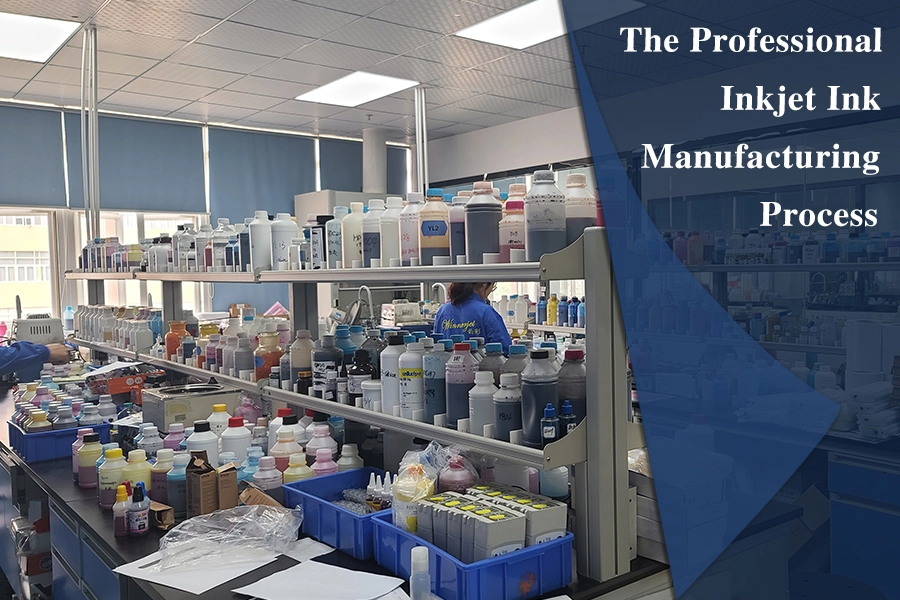
Industrial-grade manufacturers utilize advanced chemical R&D teams and fully automated production lines. Every drop of ink undergoes a strict triple nano-filtration process, ensuring that the particle size is strictly controlled below 0.2 μm. This guarantees fluid stability during high-speed, continuous printing, thereby significantly extending the lifespan of expensive printheads.
2. International Environmental Certifications (OEKO-TEX & GOTS)
If your printing clients are manufacturing for global apparel brands, the finished prints must meet stringent chemical safety standards. Premium international source factories provide fully traceable certification chains:
OEKO-TEX Standard 100 (Eco-passport)
GOTS Certification (Global Organic Textile Standard)
REACH & RoHS Compliance
3. Superior Transfer Rate and High-Density Deep Black
Formulated with high-purity disperse dyes, these inks exhibit an exceptionally high release rate during the heat transfer process. This means minimal ink residue remains on the transfer paper, resulting in more vibrant color reproduction and higher saturation on the fabric. In actual production, this saves a substantial amount of ink consumption per square meter for the printing factory.
⚖️ Local Indian Suppliers vs Global Source Factories
| Comparison Dimension | Local Indian Blending Plants / Distributors | Premium Global Industrial Source Factories |
|---|---|---|
| Primary Advantage | Fast domestic logistics, no import tariff hassles. | Exceptionally superior chemical stability, most competitive factory-direct wholesale prices. |
| Filtration Process & Precision | Variable and inconsistent (typically 0.3μm - 0.5μm). | Strict triple nano-filtration (≤ 0.2μm). |
| Color & Black Performance | Standard colors; black tones are prone to turning reddish or greenish. | Advanced Deep Black formulas; wide and saturated color gamut. |
| International Compliance Certifications | Rarely possesses traceable export-grade certifications for Europe and America. | Fully equipped with OEKO-TEX Standard 100 & GOTS. |
| Supply Chain Control | Relies on imported core dyes; prices fluctuate easily. | Vertically integrated supply chain; R&D and raw materials are autonomously controlled. |
🔗 Bypassing Middlemen: How to Direct-Connect with Global Source Factories?
If you are a financially strong local channel wholesaler in India or a scale-driven textile printing factory pursuing production stability, establishing a direct partnership with a global source factory can bring you massive cost and competitive advantages.
For local Indian wholesalers or large textile printing factories, directly partnering with a global source factory not only means cutting your costs by 20% to 40%, but it also means you gain direct access to the manufacturer’s technical support.
So, as an Indian buyer, how can you efficiently find and complete your first direct connection with an international factory? Here is the standard process:
1. Identify a Genuine “Source Factory”
When searching on Google or other platforms, do not just look at the price. Look for suppliers that feature:
R&D Depth: Owning independent ink laboratories and at least 15+ years of industry experience (for instance, Winnerjet possesses nearly 20 years of ink R&D background).
Qualifications & Certifications: The ability to proactively provide scanned copies of OEKO-TEX, GOTS, MSDS, and ISO production system certifications, rather than just verbal promises.
Production Scale: Capable of providing video tours of their production lines or supporting third-party factory audits.
2. Determine Logistics & Trade Terms (Incoterms)
International factories typically support the following export modes to India:
FOB (Free On Board): The factory is responsible for transporting the ink to a Chinese port (such as Guangzhou, Shenzhen, Dongguan, etc.) and handling export customs clearance. This is most beneficial for large Indian buyers who have their own shipping forwarders in China.
CIF (Cost, Insurance, and Freight): This is the most hassle-free method for Indian buyers. The factory handles the shipment of goods to core Indian ports (such as Nhava Sheva, Mundra, or Chennai) and covers marine insurance. You only need to arrange local customs clearance at the port.
Air Freight / Express: For urgent samples or small batch replenishment (within 100kg), you can choose FedEx/DHL or dedicated air lines, which usually arrive in India within 5-7 days.
3. Prepare Essential Documentation for India Customs
The advantage of directly dealing with a mature international factory is that we provide a complete set of compliant documentation to ensure smooth passage through Indian Customs:
MSDS (Material Safety Data Sheet): Indian Customs is very strict with chemical inspections; we provide bilingual (Chinese-English) MSDS.
COO (Certificate of Origin): Depending on trade agreements, we can assist in issuing certificates of origin to optimize import tariffs.
Bill of Lading, Commercial Invoice, Packing List: Ensure all information perfectly matches the physical goods to avoid port demurrage fees.
4. Acquire Customized Quotes & Sample Testing
Actionable Advice: Do not place large bulk orders immediately. Your first step should be initiating communication through official channels (website email or official WhatsApp).
- State Your Requirements: Specify the printhead models you use (e.g., Epson i3200-A1) and your daily ink consumption.
- Request Sample Testing: For example, Winnerjet provides a dedicated sample testing program for Indian clients. We can mail 1kg or 5L test packs, allowing you to personally verify color saturation, transfer rates, and runnability on your own machines.
Today, mature international factories offer highly flexible trade terms (such as FOB, CIF), allowing goods to be shipped directly to core Indian ports like Nhava Sheva or Mundra. At the same time, the factory will provide a complete and proper set of Material Safety Data Sheets (MSDS) to ensure your bulk cargo clears Indian customs smoothly.
🔍 2026 Core Players in the Indian Sublimation Ink Market: Which Class Suits You Best?
When searching for a sublimation ink manufacturer in India in the Indian market, you will generally encounter several powerful players from different backgrounds. Choosing the most suitable supplier based on your production scale and compliance needs is vital:
Category 1: Local Indian Manufacturers
Representative Enterprises: Splashjet Inkjet (local long-standing developer), InkTec India, Jetbest India, etc.
Characteristics: These companies own blending factories or massive warehouses locally in India (such as in Surat or New Delhi). Their greatest advantage is fast localized service, zero customs clearance risks, and convenient local currency (INR) settlement. They are ideal for local print shops with urgent lead times and frequent small-to-medium orders.
Category 2: Large B2B Matchmaking Platforms
Representative Platforms: IndiaMART, TradeIndia.
Characteristics: These platforms are crowded with a massive number of Indian first-tier wholesalers, small workshops, and traders. Price competition here is fierce. If you only need to buy a few hundred milliliters to sample on a desktop printer (like the Epson L805), these platforms offer plenty of options. However, for industrial-scale factories looking for container-level sourcing, the supplier quality on these platforms varies wildly, making it hard to guarantee batch consistency for bulk supplies.
Category 3: Traditional Chinese Global Brands
Representative Enterprises: Print-Rite, Hongsam,inkbank.
Characteristics: These are traditional giants in the global printing consumables industry, selling through exclusive national distributor networks in India. Their products are very solid in terms of quality and brand recognition. However, because the products pass through a multi-tiered layer of “National Distributor – Regional Agent – Retailer,” the final procurement cost for end-user Indian factories tends to be high.
Category 4: Vertically Integrated Global Source Factories (Direct-Supply Mode — Top Choice for Profit Maximization)
Representative Enterprise: Winnerjet
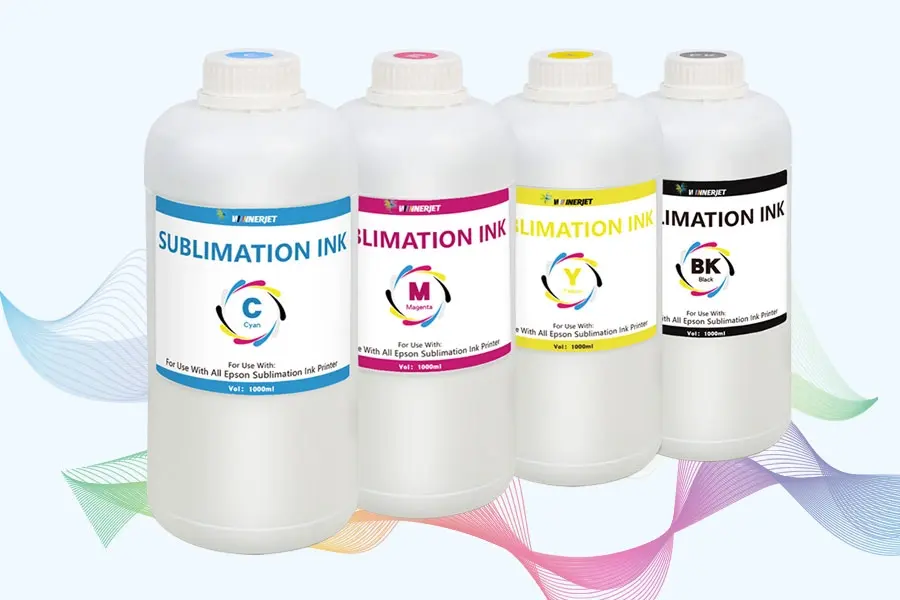
Characteristics: As a Chinese source factory with nearly 20 years of experience in ink formulation R&D and fully automated manufacturing, Winnerjet takes a different path from traditional giants—Factory-Direct Supply and OEM Customization models, offering low Minimum Order Quantities (MOQs).
📊 Want to personally verify the performance of industrial-grade ink in your own factory?
We are dedicated to helping Indian textile printing enterprises elevate their product competitiveness and break through production capacity bottlenecks. Contact our technical advisory team today, tell us the printhead models you are currently running (Epson i3200 / 5113 / DX5), and you can apply for an exclusive free sample test kit to experience the real results of high-density deep black and flawless, smooth printing.
📥 Get the latest 2026 Winnerjet Sublimation Ink Price List for the Indian Market, and let our experts customize an exclusive industrial-grade supply solution for you online.