Eco-solvent ink is inherently a pigment-based ink suspended in a low-VOC, mild organic ester carrier, engineered specifically for high-durability outdoor and commercial signage.
Colorant (Pigment Solids): Formulated with micro-milled, insoluble pigment particles (0.2μm) that provide high lightfastness and resist UV photon degradation.
Carrier (Mild Organic Solvent): Utilizes biodegradable glycol ether esters rather than water, maintaining stable viscosity and low-odor, non-hazardous indoor operation.
Bonding Action (Chemical Etching): Temporarily softens and penetrates non-porous synthetic surfaces (like raw PVC and cast vinyl) to anchor solid pigments directly into the media substrate.
Durability Performance: Delivers 24–36 months of unlaminated outdoor weather resistance against moisture, scratching, and sun fading.
How Eco-Solvent Pigment Inks Actually Work
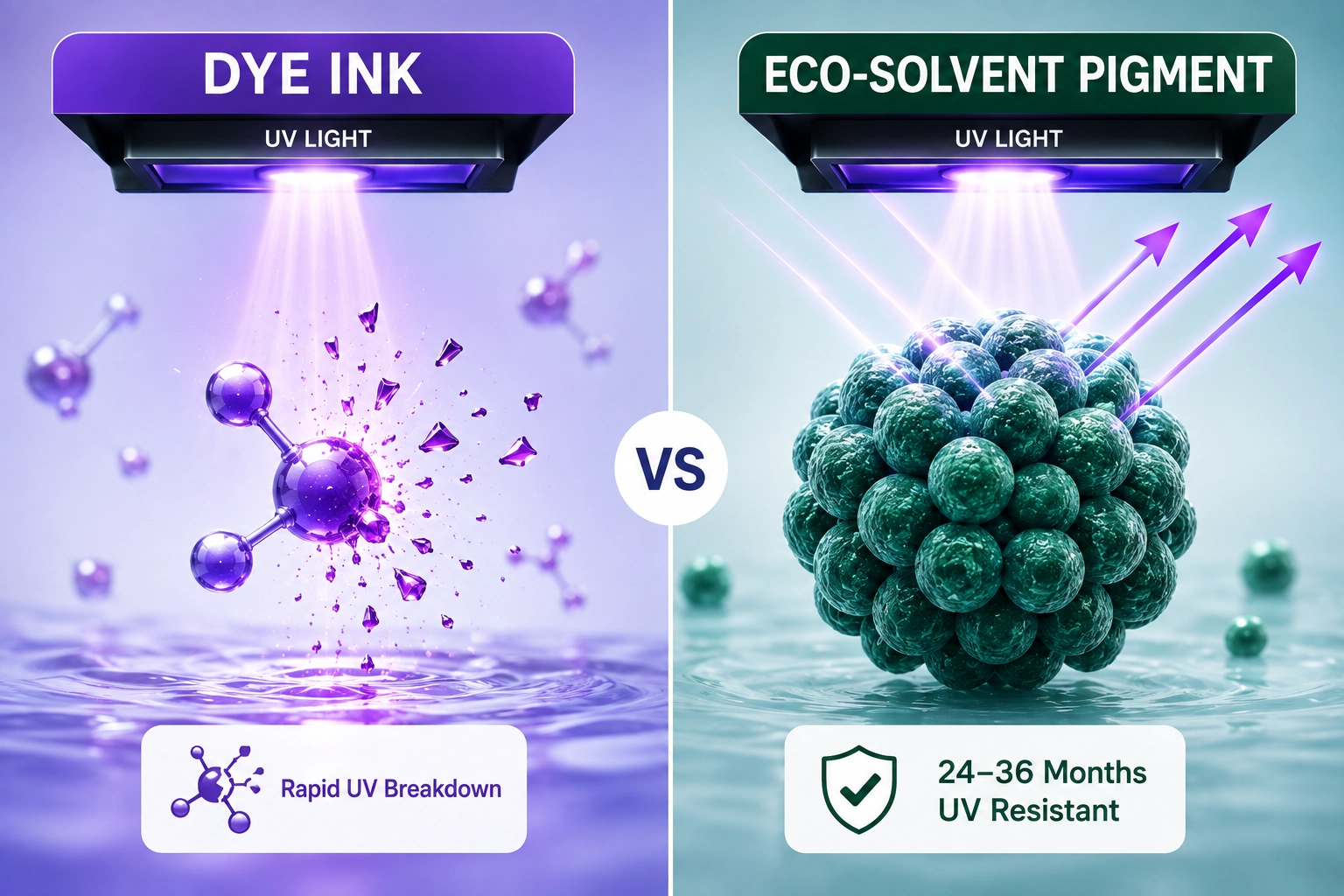
Pigment vs Dye: Dye dissolves fully in liquid and breaks down fast under direct UV sunlight. Eco-solvent inks use solid, insoluble pigment particles ($<0.2\text{ }\mu\text{m}$) that physically block UV rays, keeping outdoor prints vibrant for 24–36 months without lamination.
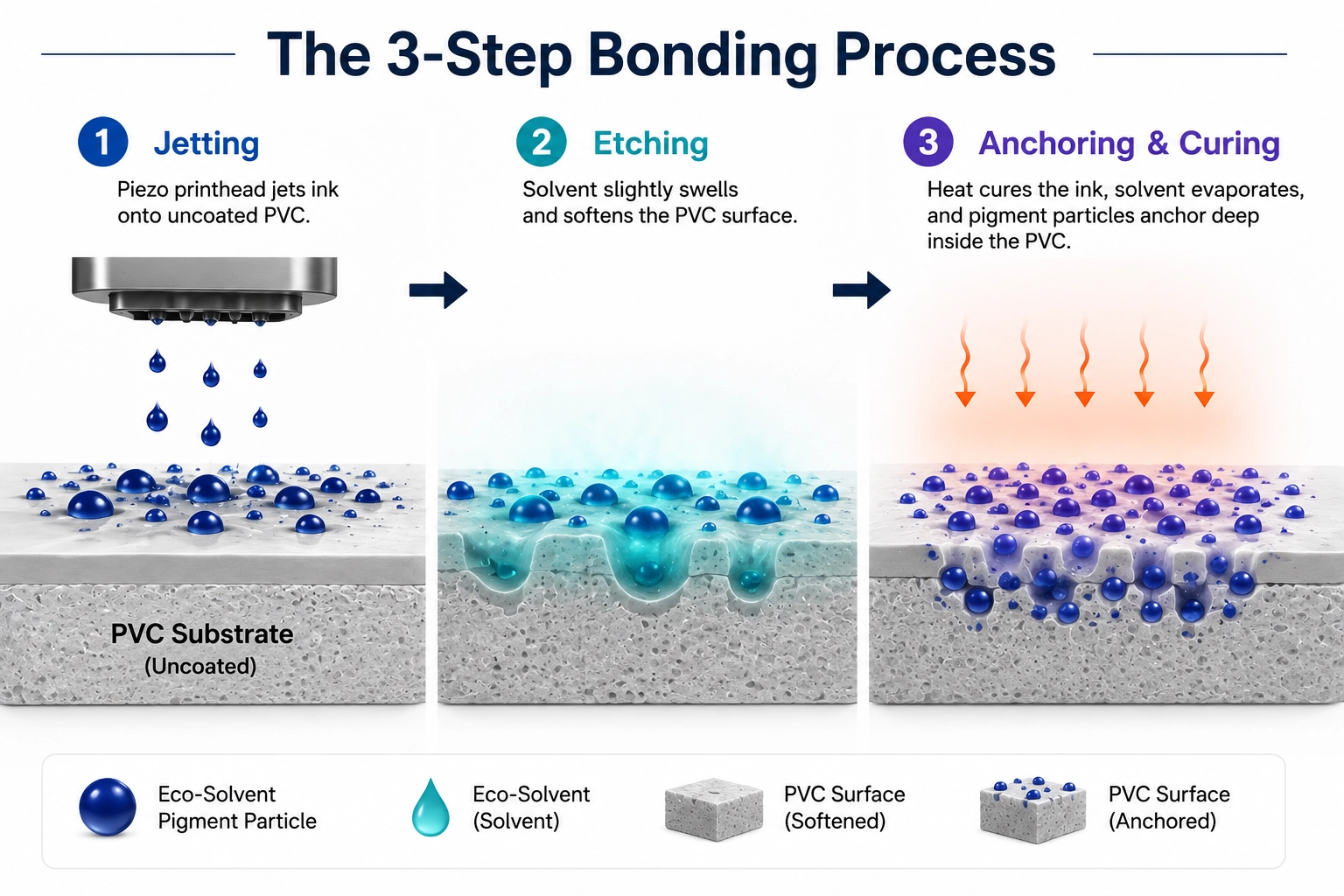
Chemical Etching (3 Steps):
Jetting: Piezo printheads fire fine pigment-solvent droplets onto raw, uncoated media.
Etching: Mild solvents temporarily soften the top layer of PVC/vinyl.
Anchoring & Evaporating: Built-in heating drives off the solvent while pigments lock directly into the resealed surface, creating a scratchproof, waterproof finish.
Eco-Solvent (Pigment) vs Aqueous Dye vs Aqueous Pigment
| Core Metric | Eco-Solvent (Pigment) | Aqueous Dye | Aqueous Pigment |
|---|---|---|---|
| Colorant Base | Insoluble Nano-Pigment (<0.2 µm) | Dissolved Dye Molecules | Insoluble Solid Pigment |
| Carrier Liquid | Low-VOC Organic Esters | Deionized Water | Deionized Water |
| Outdoor Lifespan | 24–36 Months (Raw/Unlaminated) | Days to 3 Months (Fades fast) | 6–12 Months (Needs coating) |
| Media Required | Uncoated PVC / Raw Vinyl | Coated Photo Paper Only | Coated Fine Art Paper Only |
| Water & Scratch Resistance | High (Chemical surface fusion) | None (Water soluble / Bleeds) | Moderate (Water-safe, low scratch) |
| Best Used For | Car wraps, outdoor banners, stickers | Indoor photos & quick office prints | Museum art reproductions & photos |
Winnerjet’s precision-engineered eco-solvent ink is a high-density, pigment-based formulation—not a dye. Unlike water-based dye inks that degrade rapidly under UV exposure or aqueous pigments that require expensive coated media, our industrial eco-solvent chemistry uses mild organic esters to chemically etch and lock nano-milled pigments directly into uncoated PVC and vinyl for 24–36 months of unlaminated outdoor durability.
Debunking the Myth: Why “Dye-Based Eco-Solvent” Doesn’t Exist
A persistent myth originating from older community threads (such as this discussion on T-Shirt Forums) claims that “eco-solvent is just a broad marketing term for either dye or pigment inks in a solvent base.”
From a modern chemical manufacturing and industrial printing perspective, dye-based eco-solvent ink does not exist in commercial production. Here is why:
The sole purpose of developing eco-solvent hardware is to produce long-lasting outdoor signage, fleet wraps, and heavy-duty decals on low-cost, uncoated PVC/vinyl media. Formulating a dye-based solvent ink completely invalidates this purpose because dissolved dye molecules break down within weeks under direct sunlight.
Mild glycol ether ester solvents are engineered to soften vinyl so solid nano-pigments can physically lock into the synthetic matrix. Dissolved dye molecules cannot form this durable physical layer and instead bleed into or discolor the vinyl without mechanical stability.
Producing a specialized solvent-resistant printhead system just to jet non-lightfast dye ink offers zero commercial return. Every certified commercial eco-solvent ink on the market—from OEM formulations to high-grade factory-direct alternatives—is 100% pigment-based.
Eco-Solvent Ink Printhead & Tubing Compatibility
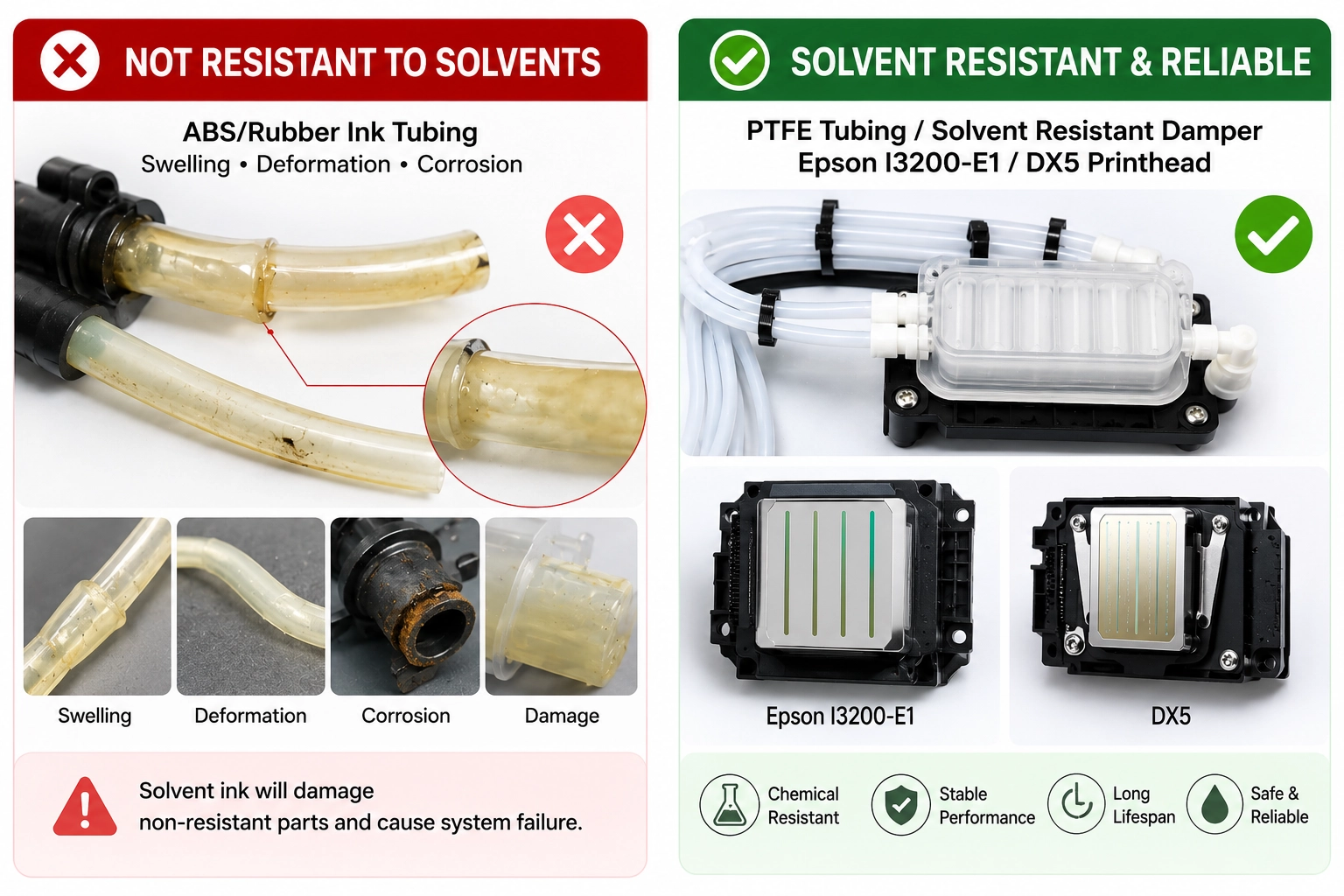
Do not fill standard desktop water-based printers with eco-solvent ink.
While both use piezoelectric technology, their internal material engineering is entirely different:
What Happens in a Water-Based Printer: Standard desktop ink lines, dampers, and printheads rely on ABS plastics and rubber O-rings engineered exclusively for water. Organic ester solvents will swell and dissolve these internal seals within 24–48 hours, causing catastrophic ink leaks, internal short circuits, and delaminated printhead glue.
Required Solvent-Resistant Hardware: Eco-solvent inks demand industrial-grade PTFE (Teflon) tubing, solvent-resistant dampers, and certified piezoelectric printheads.
Compatible Printhead & Machine Standards:
Epson I3200-E1 (Eco-solvent series), Epson DX5/DX7 (Solvent-locked or unlocked solvent versions), and XP600 (Solvent build).
Roland (TrueVIS, VersaSTUDIO BN-20, VS series), Mimaki (JV/CJV series), Mutoh (ValueJet series), and configured industrial wide-format printers.
When Should You Use Eco-Solvent Inks?
co-solvent pigment inks are engineered for commercial applications that demand outdoor endurance, flexible vinyl adhesion, and resistance to environmental stress:
Vehicle Wraps & Decals: Withstands constant UV exposure, highway grit, rain, and the thermal stretching required to wrap complex curves without cracking or flaking.
Outdoor Banners & Backlit Displays: Delivers vibrant color saturation and high optical density on raw PVC, frontlit banners, and backlit mesh for roadside visibility.
Durable Vinyl Stickers & Floor Graphics: Resists direct mechanical abrasion, foot traffic, and daily chemical cleaning without immediate protective lamination.
OEM vs Factory-Direct Compatible Eco-Solvent Inks (Buyer’s Decision Guide)
Print shops often weigh the high cost of original equipment manufacturer (OEM) cartridges against compatible alternatives:
95%+ Gamut Match & Zero Clogging: High-grade factory-direct inks undergo nano-scale wet milling to achieve pigment particle sizes under $0.2\text{ }\mu\text{m}$. This matches OEM color gamuts by over 95% while keeping jetting consistency stable without nozzle dropouts.
Up to 70% Production Savings: Sourcing ink directly from certified manufacturers significantly lowers your cost per square meter compared to single-use OEM cartridges.
Looking for reliable, printhead-safe ink formulations? Explore high-density Winnerjet Eco-Solvent Inks engineered for Roland, Mimaki, Mutoh, and Epson I3200-E1 printers.
Does your printing facility require custom ink formulations, bulk supplies, or technical advice? Please contact our technical team for free sample testing and expert consultation.
FAQs – Eco-Solvent Inks
Can I convert a desktop printer to eco-solvent ink?
No. Desktop printers use non-resistant ABS plastics and rubber seals that dissolve within days from organic solvents, causing severe leaks and ruined printheads. Eco-solvent requires dedicated PTFE tubing and solvent-rated piezo heads.
Does eco-solvent ink require heat to dry?
Yes. Wide-format eco-solvent printers use built-in 3-stage heating (35°C–45°C) to soften PVC media for deeper pigment bonding and to speed up solvent evaporation. UV lamps are not needed.
What does "Eco" mean in eco-solvent?
“Eco” stands for Ecological and Economical. It uses low-VOC, mild glycol ether esters instead of the toxic cyclohexanone found in hard solvents, significantly reducing odors and workplace hazards.