Direct-to-Garment (DTG) profitability comes down to three factors: initial machine price, real ink consumption, and maintenance downtime.
To evaluate these metrics, we cross-referenced official hardware documentation and distributor benchmarks from Brother DTG Official and Ricoh DTG Official. (Note: While Ricoh has upgraded active lineups to models like the Ri 1000 Pro/Ri 2000, the Ri 1000 remains widely traded in certified pre-owned markets).
Quick Brother gtx pro vs Ricoh ri 1000
Buy the Brother GTX Pro if: You prioritize automated white ink circulation, higher printhead speeds, and steady, high-volume production without frequent maintenance interruptions.
Buy the Ricoh Ri 1000 if: You are budget-conscious, need durable industrial piezo printheads, and want a lower upfront equipment investment for boutique or short-run jobs.
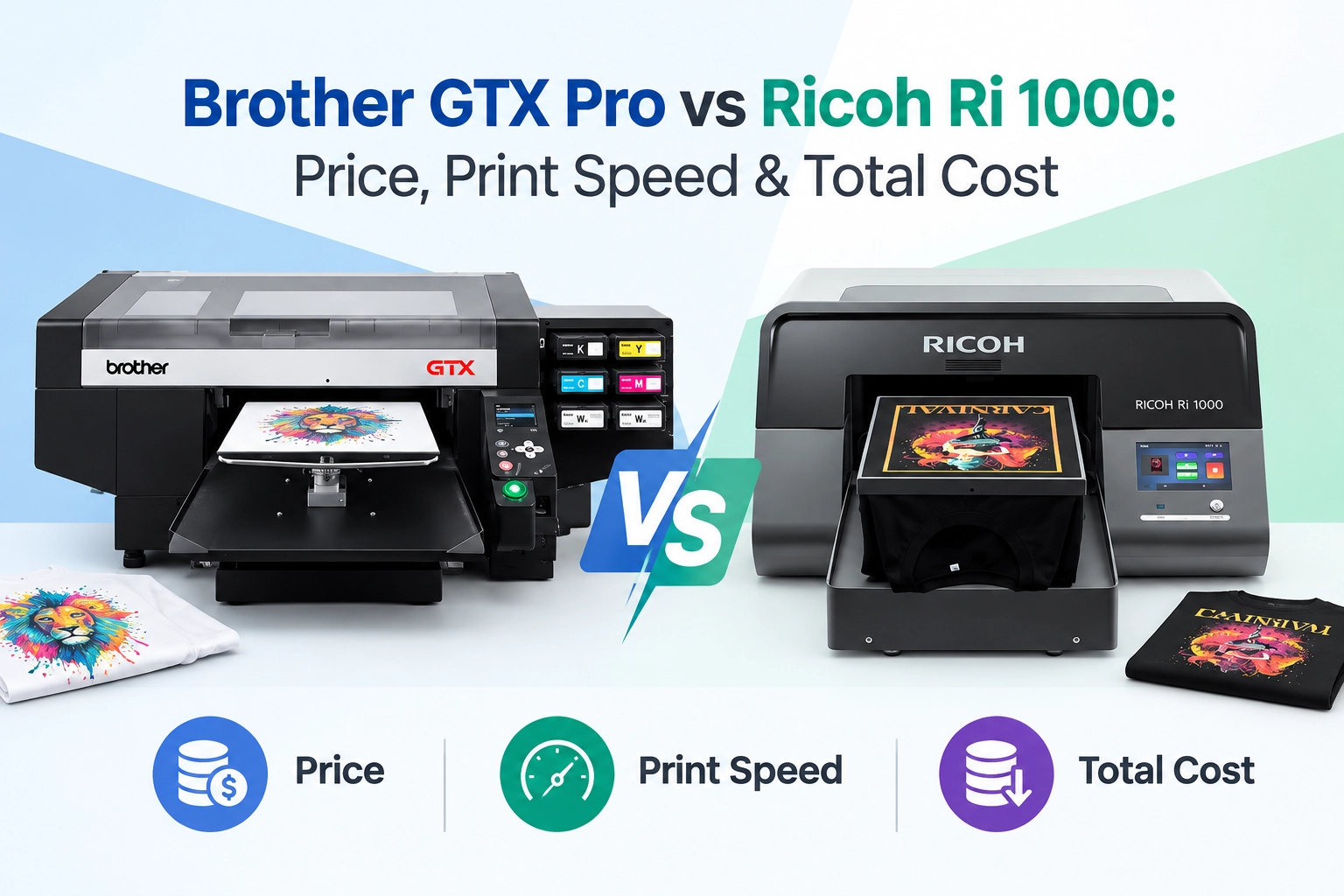
Specifications & Core Metrics: Brother GTX Pro vs Ricoh Ri 1000
Consult the table below to compare the basic information and specifications of these two devices and discover that:
The Brother GTX Pro leads in continuous dark-garment speed and rush volume, while the Ricoh Ri 1000 wins on lower upfront cost and a compact footprint.
| Factor | Brother GTX Pro | Ricoh Ri 1000 | Takeaway |
|---|---|---|---|
| Equipment Price | ~$22,000 – $25,000 (New) | ~$13,995 – $14,500 (MSRP) / ~$7,000 – $9,000 (Used) | Ricoh has a ~40% lower entry cost; Brother suits production-level budgets. |
| Print Speed (Dark) | ~75 – 90 sec (Single-pass) | ~90 – 120 sec (Speed mode) | Brother is noticeably faster for daily volume runs on dark garments. |
| Print Area | 16" × 21" (40.6 × 53.3 cm) | 16" × 19.6" (40.6 × 50 cm) | Both cover standard oversized prints; Brother adds ~1.4" length. |
| Ink Capacity | 700 ml pouches (Bulk available) | 220 ml cartridges | Brother holds more volume; Ricoh requires more frequent cartridge swaps. |
| White Ink System | Internal printhead circulation | Scheduled line flush & alerts | Brother offers superior anti-clog protection during idle periods. |
Equipment Price: How does the Brother GTX Pro compare to the Ricoh Ri 1000?
Third-party reference benchmarks based on actual market prices
Due to regional dealership agreements, manufacturers of industrial-grade DTG (Direct-to-Garment) equipment rarely publish fixed list prices on their official websites. To obtain an accurate price comparison, we consulted current quotes provided by authorized dealers:
Ricoh Ri 1000: Listed by authorized dealer DTG PRO at approximately $13,774 – $14,500; however, the item is currently out of stock.(For an in-depth breakdown of secondary market pricing and package options, check out our guide on how much a Ricoh Ri 1000 costs).
Brother GTX Pro: Quoted by major master distributors such as Hirsch Solutions (HSI) at prices ranging from $22,000 to over $25,000.
The pricing dilemma between the two major brands
Ricoh Ri 1000: While the entry price is notably lower, the original model has been phased out from Ricoh’s active catalog, making buyers choose between older stock and costlier newer generations.
Brother GTX Pro: Backed by high industrial build quality, but the steep $20,000+ capital barrier poses a heavy upfront financial burden for growing print businesses.
Winnerjet helps your dtg printing production development
Whether your shop invests in the Brother GTX Pro or the Ricoh Ri 1000, daily production shouldn’t be held hostage by expensive OEM consumable markups.
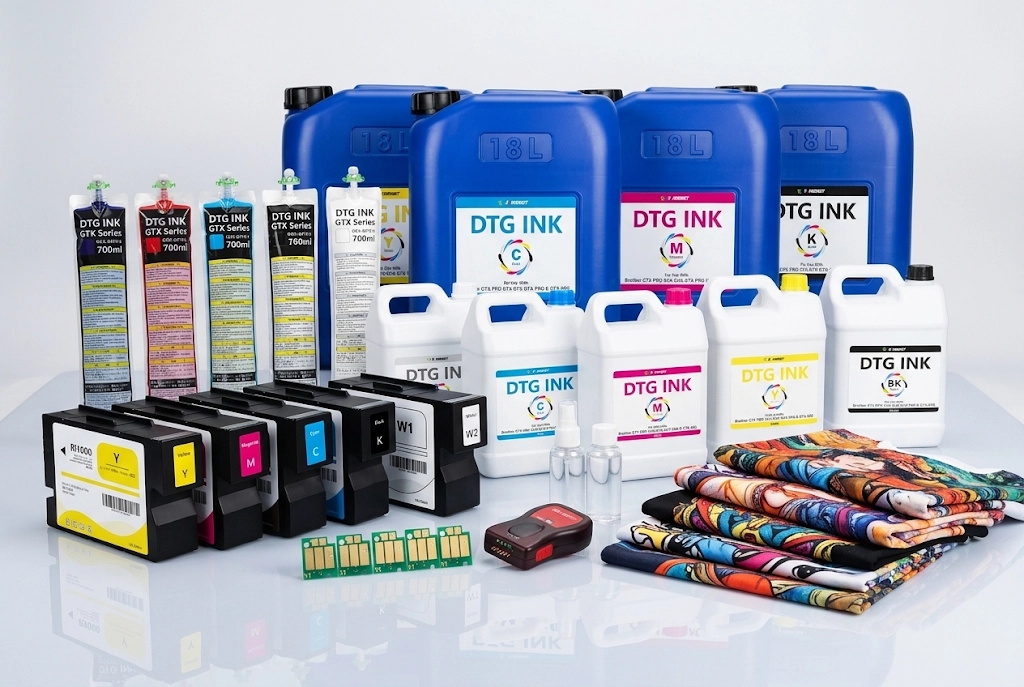
As a dedicated digital printing consumables manufacturer, Winnerjet delivers a complete, one-stop consumables ecosystem specifically engineered for both printer models. From replacement cartridge chips and resetters to high-yield ink pouches and premium DTG pigment inks, our formulas match OEM color gamut, printhead flowability, and wash fastness.Learn more about our DTG product range.
Operational Costs & Total Cost of Ownership: Real-World Breakdown
Costs Beyond Hardware: Electricity and Manufacturer Warranty
Purchasing the machine is only the first step. Long-term profitability is dictated by daily electricity, ongoing maintenance, and extended warranties.
According to industrial production benchmarks and service package rates from Hirsch Solutions (HSI) and DTG PRO:
Extended Warranty & Service Contracts: Brother’s annual extended protection contracts typically range from $2,000 to $3,500/year, whereas Ricoh service coverage plans hover around $1,500 to $2,200/year.
Power Consumption: Both machines operate on standard 100–120V AC lines (~0.8 kW for Brother vs. ~0.5 kW for Ricoh in peak print modes), translating to roughly $150 – $300 annually in typical workshop electricity bills.
Simulated Production Scenario (50 Shirts/Day, 250 Days/Year)
Based on tracking data and operational feedback from the global printing facilities we partner with, we have simulated and calculated the costs associated with standard daily production operations in an actual manufacturing environment:
| Printer Model | Production Efficiency | Annual OEM Consumables Cost (50 shirts/day) | Routine Maintenance Overhead |
|---|---|---|---|
| Brother GTX Pro | Faster output, lower labor hours per run | $12,000 – $15,000 | Automated head circulation, fewer manual touchpoints |
| Ricoh Ri 1000 | Standard output, higher swap frequency | $14,000 – $16,500 | Frequent small cartridge swaps, manual capping upkeep |
Operational Cost vs Lifecycle Performance
When evaluating the long-term return on investment for printing equipment, you must also consider factors such as the replacement of wear parts, warranty policies, and the cumulative consumption of daily consumables over years of operation.
| Cost Category | Lifespan | Impact on Hardware Performance |
|---|---|---|
| Printheads | 1.5 – 3 Years | Brother’s built-in circulation resists clogs under heavy loads; Ricoh requires disciplined manual flushes to prevent white ink settling. |
| Warranties | Years 2 – 5 | Both brands tie coverage to OEM inks, adding $1,500 – $3,500/year in fixed operational overhead. |
| Electricity | Ongoing | Ricoh consumes slightly less standby power; Brother runs slightly more frequent agitation cycles. |
| Inks & Maintenance | Ongoing | Daily inks, flush solutions, and maintenance tanks make up over 70% of total machine lifecycle expense. |
The Brother GTX Pro delivers lower per-shirt costs and less maintenance hassle for high-volume production, while the Ricoh Ri 1000 is cheaper to start with but ends up costing more in daily ink and upkeep as your print runs scale.
Maintenance, Part Replacements & Wear: Which Machine Keeps Running?
Among the hundreds of custom print shops our technical team supports, the biggest profit drain is never the initial equipment sticker price—it’s sudden, unscheduled downtime during peak order cycles. We frequently see shops lose thousands of dollars in delayed rush orders simply because white ink settled over a two-day weekend, or because a chipped maintenance box locked the machine mid-run, forcing hours of heavy flushes while waiting on expensive OEM replacement parts.
| Component | Brother GTX Pro | Ricoh Ri 1000 | Takeaway |
|---|---|---|---|
| Printhead | Single assembly (~$2,500 – $3,200); built-in circulation resists clogs | 4 modular heads (~$800 – $1,200 each); requires manual calibration | Ricoh costs less to replace per head; Brother clogs far less often. |
| Capping & Wiper | Automated wet capping; replace every 6–12 months | Semi-automated; requires weekly manual wiping (replace every 4–8 months) | Brother requires significantly less daily manual cleaning labor. |
| Ink Line System | Active white ink circulation; quick recovery after idle periods | Static lines; requires frequent flushes and manual cartridge shaking | Brother is far safer for shops with weekend or seasonal downtime. |
| Waste Box & Chip | Chipped waste tank; locks when full | Chipped pad/bottle; fills rapidly during automated flushes | Both lock up during heavy production; alternative chips prevent sudden stops. |
Routine Maintenance Demand
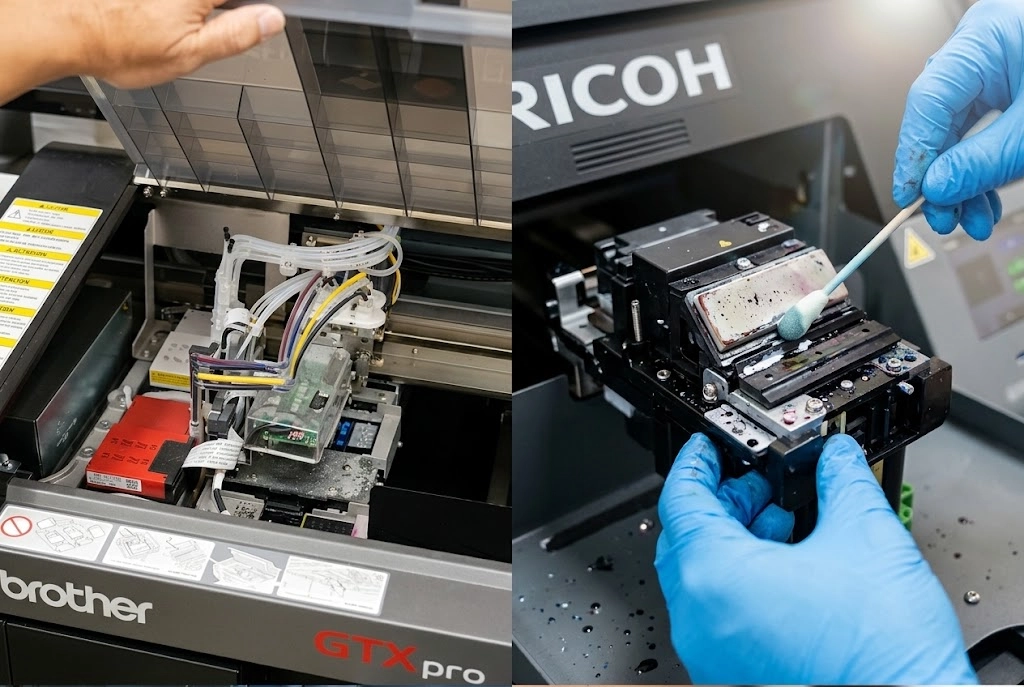
- Brother GTX Pro: Mostly automated. Needs quick weekly manual sponge swab around the cap and occasional filter checks.
- Ricoh Ri 1000: Requires disciplined daily and weekly manual upkeep, including printhead edge swabs, wiper blade cleaning, and scheduled flush cycles.
The Brother GTX Pro wins on maintenance automation and long-term peace of mind, while the Ricoh Ri 1000 saves you money on single-part repairs but demands stricter daily cleaning discipline to avoid costly clogs.
Performance Comparison: Print Speed, Power & Environmental Tolerance
While the Brother GTX Pro prioritizes peak garment throughput with single-pass CMYK + White printing at roughly 0.8 kW, the Ricoh Ri 1000 trades top-end speed on dark shirts for energy efficiency, drawing only about 0.5 kW peak and a modest 50W in standby.
Noise Levels & Shop Environment Requirements
The following specifications regarding environmental tolerance, operating noise levels, and temperature/humidity control have been compiled based directly on official equipment engineering specifications and technical compliance white papers from Brother and Ricoh.
| Factor | Brother GTX Pro | Ricoh Ri 1000 | Quick Takeaway |
|---|---|---|---|
| Noise | 65 – 70 dB (Audible gear drive) | 55 – 60 dB (Noticeably quieter) | Ricoh suits retail/offices; Brother fits production floors. |
| Temp & Humidity | 18 – 30°C / 45 – 85% RH | 15 – 32°C / 45 – 80% RH | Both require climate control; <40% humidity risks white ink crusting. |
| Dust & Lint | Enclosed build, higher lint defense | Semi-open platen, collects lint easily | Brother protects internal rails better in high-dust textile spaces. |
If your setup is in a customer-facing boutique or retail kiosk, the Ricoh Ri 1000 is quieter and runs cooler. For dedicated commercial production shops with conditioned environments, the Brother GTX Pro easily wins on sheer production velocity and dust resistance.
Investment Value: Is a Used Machine Worth It?
While the Ricoh Ri 1000 is officially discontinued and the new Brother GTX Pro runs $22,000 – $25,000+, both models trade heavily on the second-hand market:
Used / Refurbished Ricoh Ri 1000 ($6,000 – $9,000):
Offers an accessible sub-$10k entry point with a rapid 3-to-6-month payback cycle, though idle units risk dried white ink lines. You can source tested units through authorized distributors like DTG PRO (factory refurbished) or peer-to-peer apparel equipment hubs like Digitsmith and the T-Shirt Forums Classifieds (always require a live 100% white nozzle check before purchase).
Used / Pre-Owned Brother GTX Pro ($14,000 – $18,000):
Saves substantial capital over a new build while keeping industrial single-pass speeds and automated internal white-ink circulation. High-integrity units can be acquired directly via Brother Certified Pre-Owned (CPO) programs, master distributor inventory like Hirsch Solutions (HSI), or shop-liquidations on Digitsmith.
Suggestion: Pick a inspected used Ricoh Ri 1000 from reputable trade forums for low-budget startups; choose a certified pre-owned or new Brother GTX Pro from authorized distributors if you already run daily volume and need automated, clog-free production.
Market Trends: Brother GTX Pro vs Ricoh Ri 1000
According to recent industry market analyses from the PRINTING United Alliance SODA Reports and FESPA’s textile production insights, apparel decorators are aggressively moving away from 100% cotton-only restrictions. Shops increasingly use their existing Brother and Ricoh DTG flatbeds to print directly onto transfer film sheets (hybrid DTG-to-film), expanding into dark polyester, nylon, and cap orders without adding standalone machinery.
Whether operating Brother GTX Pro or Ricoh Ri 1000 setups, Winnerjet delivers factory-direct consumables that address shop profit margins directly:
- 40%–60% Lower Ink Spend: Industrial-grade pigment inks matched to OEM color gamuts and wash durability.
- Zero Downtime Risks: Fully tested cartridge chips, waste tank resetters, and daily flushing fluids ship direct from the source.
- Seamless DTG/DTF Dual Use: Precision viscosity formulas let you handle direct cotton prints and DTF transfers using the same ink set.
Ready to expand your print capabilities while cutting consumable costs?
Contact Winnerjet today to request test ink samples and complete chip compatibility sets for your machines.