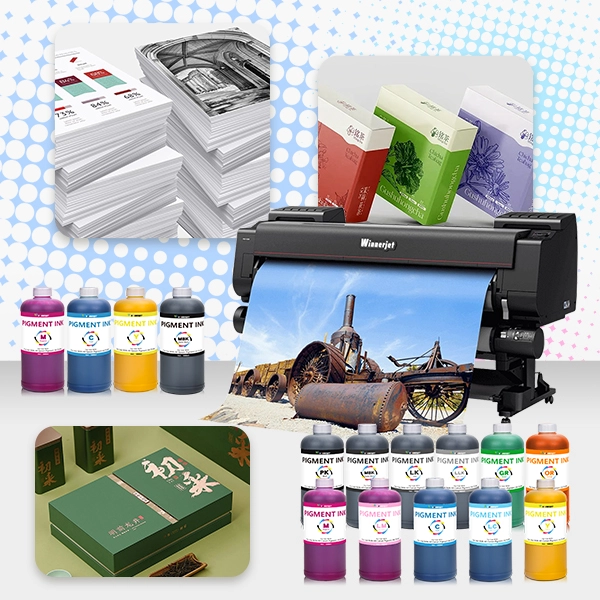
Pigment ink (meaning and definition): Pigment-based ink is a durable printing ink formulated with microscopic solid particles suspended in a liquid carrier, rather than chemical dyes dissolved in water. It is designed for printers that require superior lightfastness, water resistance, and archival longevity.
It is primarily used in the following areas:
- Printing Documents and Photos
Pigment ink is water-resistant, fade-resistant, and UV-resistant, making it ideal for printing documents, certificates, photos, and artwork that require long-term preservation. - Artistic Reproduction and Professional Image Output
In professional inkjet printers, pigment ink is widely used for giclée printing and high-end photographic printing because it offers enhanced color stability and durability. - Industrial Printing
In industries such as textiles, packaging, labels, and advertising printing. Pigment ink provides stable coloring and is resistant to scratching on a variety of substrates, such as paper, fabric, plastic, and metal film. - Office and Educational Uses
Because pigment ink is highly water-resistant, printed documents are not easily damaged by water or light in everyday use. Therefore, it is often used for printing contracts, documents, assignments, and more.
What Makes a Truly Durable Ink Pigment?
Insoluble Particles for Waterproof Prints
Pigment ink uses solid microscopic particles that physically bond to the surface rather than dissolving in water. Once dry, the printed content remains completely waterproof, smudge-proof, and resistant to moisture or sweat.
UV Degradation Resistance for 100+ Years
Unlike dye molecules that break down under sunlight, the crystalline structure of durable ink pigments reflects ultraviolet radiation. This prevents color fading, preserving fine art giclée prints and outdoor signs for decades.
Resin Encapsulation for Scratch Resistance
Specialized resin binders encapsulate the pigment particles during the curing process, forming a durable protective film. This shields packaging labels and legal documents from friction, daily handling, and highlighter markers.
How to Use Pigment Ink:
Usage and Precautions for Pigment Ink in Different Printing Scenarios
Pigment Ink for Printers: Compatible Models & Printheads
Before printing, verify that your printer hardware is engineered for pigmented formulations to prevent printhead clogging.
Fine Art & Photography Printers: Epson SureColor P-Series (P600, P800, P900, P5000+), Canon imagePROGRAF PRO Series (PRO-1000, PRO-2100, PRO-4100).
High-Speed Office & Document Printers: HP PageWide Enterprise Series, Epson WorkForce Pro Series, Canon MAXIFY.
Commercial & Industrial Printheads: Epson I3200 (A1/E1), Ricoh Gen5/Gen6, Konica Minolta 1024i, StarFire.
I. Usage for General Document Printing
Applications: Office documents, contracts, assignments, and archival storage
Instructions:
Use an inkjet printer that supports pigment ink (such as some models from Epson, Canon, and HP).
Choose printing paper suitable for pigment ink (typically matte paper, regular copy paper, or photo paper).
Gently shake the ink bottle or cartridge before printing to prevent settling.
After printing, let the paper air dry for 5-10 minutes to prevent the ink from smudging.
✅ Advantages: Printed documents are waterproof, fade-resistant, and can be preserved for years. II. Usage in Giclée Printing and Photographic Printing
Applications: High-end photography, gallery-quality art reproductions
Instructions:
Use a professional-grade inkjet printer (such as the Epson SureColor P series).
Select professional fine art paper (such as cotton canvas, fine art paper, RC photo paper, etc.).
Select “High Quality Mode” in the print settings and use an ICC color profile for color correction.
After printing, let the print sit in a dry environment for 24 hours before mounting.
✅ Advantages: Accurate colors, long-lasting color resistance, suitable for art collections and exhibitions.
III. Usage in Industrial Printing
Applications: Labels, packaging, textiles, advertising printing, etc.
Instructions:
Use an industrial printhead (such as the Epson I3200, Ricoh, Konica, etc.) and a UV curing system.
Select the appropriate ink type based on the substrate (such as textile-specific pigment ink, PVC film ink).
After printing, heat pressing, drying, and UV curing can be used to improve adhesion.
✅ Advantages: Durable coloring, waterproof and light-resistant, suitable for outdoor use and large-scale production.
IV. Usage in Education and Home
Applications: Printing handouts, homework, educational charts, and learning materials
Instructions:
Use a home inkjet printer and refill with pigment ink.
Use regular printer paper; no special coating is required.
Printed paper is immediately touchable and resistant to smudging.
✅ Advantages: Low cost, waterproof, and light-resistant, so children’s sweaty hands won’t cause smudges.
⚠️ Precautions:
Pigment ink has larger particles. Do not mix with dye ink, as this may clog the nozzle.
When the printer is not in use for an extended period, it is recommended to print one or two pages per week to prevent the nozzle from drying out.
Store the ink away from light and heat, and keep the bottle cap tightly closed to prevent oxidation.
Where can I buy high-quality pigment ink?
You can purchase high-quality pigment inks from Winnerjet (official website: winnerjet.com).
For high-quality pigment inks, we recommend visiting the Winnerjet official website (winnerjet.com). Winnerjet specializes in producing and selling pigment inks compatible with various inkjet printer brands (such as Epson, Canon, and HP). These inks offer excellent color reproduction, exceptional water and fade resistance, and support both bulk purchases and OEM customization.
On its official product page, the “Pigment Ink” series is clearly labeled as suitable for a variety of applications, including office printing, giclee prints, and packaging labels. It emphasizes “compatible with Epson/Canon/HP printers,” “vivid color performance,” and “long-lasting durability.”
If you’re an office user, photographer, fine art printer, or packaging label manufacturer, choosing Winnerjet’s pigment inks not only ensures superior water, UV resistance, and durability, but also meets compatibility and bulk purchasing needs. When purchasing, it’s recommended to confirm your printer model, ink specifications (e.g., 1000 mL/bottle), and whether you require custom packaging or branding. After understanding the application scenarios and usage methods of pigment ink, if you have more questions about pigment ink, you can read the following article or contact us.
Identify Your Current Ink Type:
Avoid printhead damage from mixing formulations. Learn how to verify your supply in our step-by-step test guide:
👉 How to Tell If Ink Is Dye or Pigment?
Calculate Commercial Printing Costs:
From desktop bottles to 1000 mL bulk packaging, plan your production budget with our price breakdown:
👉 How Much Does Pigment Ink Cost?
Master Resin & Specialty Formulations:
Working with specialty coatings or outdoor media? Understand the curing chemistry in:
👉 A Guide to Proper Use of Pigment Inks and Resin Pigment Inks
Understand the Manufacturing Chemistry:
Curious about pigment dispersion and solid particle milling? Discover the science behind:
👉 How to Make Pigment Ink from Powder
Have custom formulation or OEM packaging requirements? Contact Our Technical Support Team for free test samples and printer profile matching.