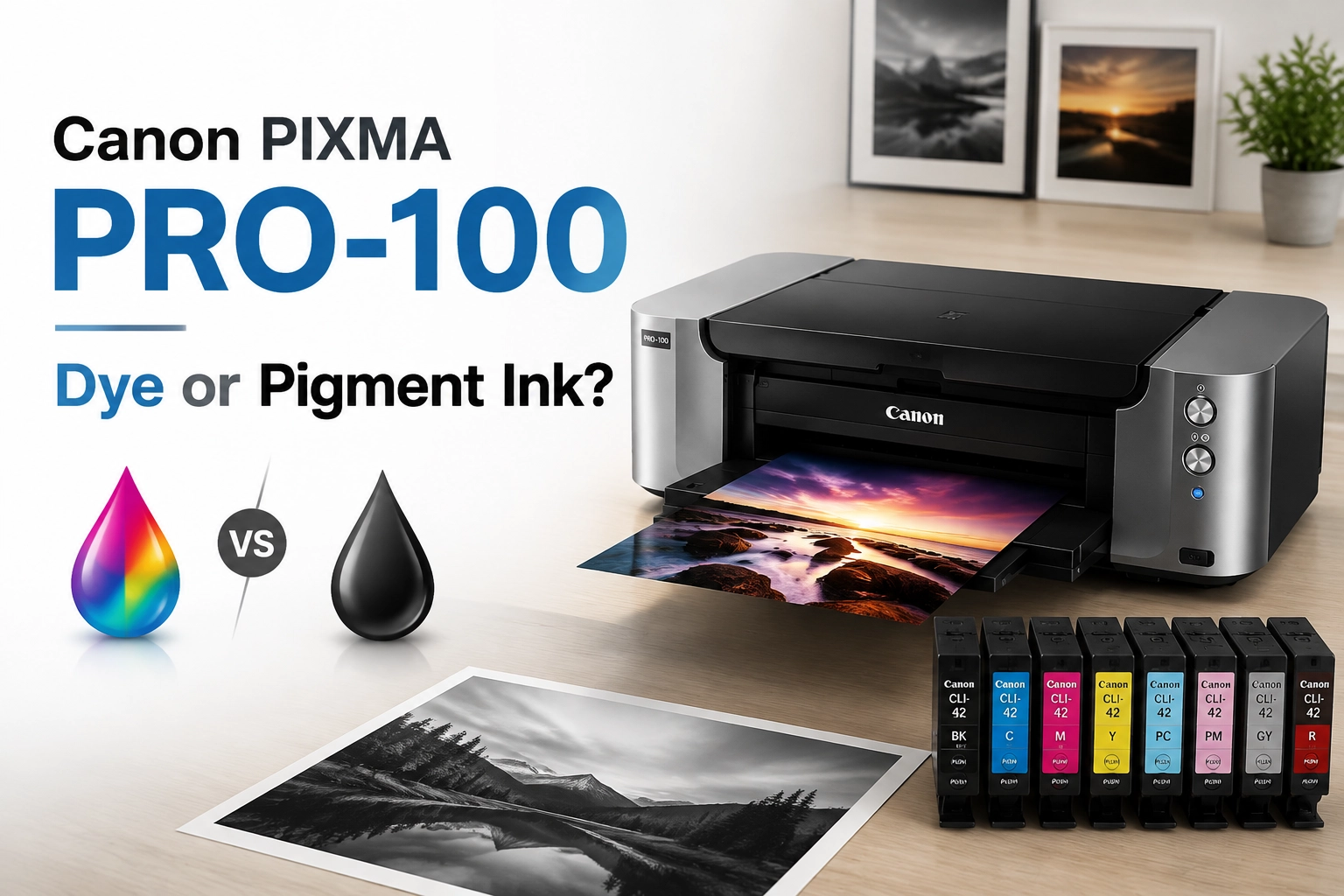
The Canon PIXMA PRO-100 uses an 8-color dye-based ink system (specifically Canon CLI-42 ChromaLife100+ series ink) rather than pigment-based ink.
Canon PIXMA PRO-100 Ink Compatibility
- Official Ink Type: 8-Color ChromaLife100+ Dye-Based Ink System (CLI-42 Series: BK, C, M, Y, PC, PM, GY, LGY).
- Best Applications: High-gloss photo printing, smooth tonal gradations, brilliant color saturation, and seamless black-and-white tonal transitions without bronzing.
- Can You Use Pigment Ink?: Not recommended. The printer’s FINE thermal printhead features micro-nozzles (3 pL) calibrated specifically for the physical viscosity, surface tension, and flow dynamics of dye ink. Loading pigment ink into original printhead lines carries a high risk of permanent nozzle clogging and ink starvation.
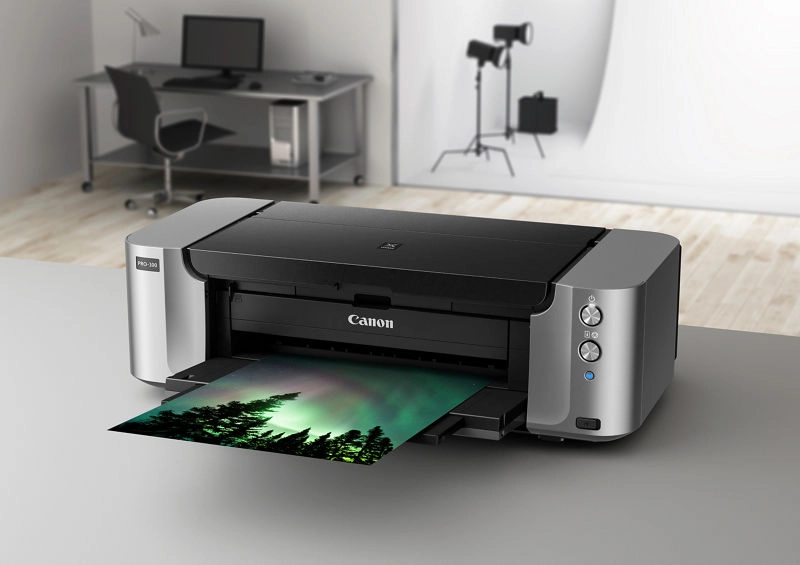
Canon PIXMA PRO-100 Uses Dye-Based Ink
The Canon PIXMA PRO-100 is a benchmark A3+ (13″) desktop professional photo printer engineered for photographers, graphic artists, and design studios seeking gallery-quality print output. Built around Canon’s advanced FINE (Full-photolithography Inkjet Nozzle Engineering) thermal printhead technology, it utilizes an 8-color dye-based ink formulation. This system integrates standard colors (Black, Cyan, Magenta, Yellow, Photo Cyan, Photo Magenta) alongside two dedicated monochrome channels (Gray and Light Gray). This precise color arrangement enables exceptionally smooth tonal gradations, vibrant color saturation, and neutral black-and-white prints with virtually zero bronzing on glossy and luster media. You can review the complete technical specifications and official CLI-42 ink profiles directly on the Canon Support Official Page.
Considerations for Using Compatible Ink
If you choose to use third-party compatible inks to manage operational printing costs, keep the following crucial factors in mind:
Ensure the ink formulation strictly matches the physical viscosity, surface tension, and boiling profile required by Canon FINE thermal printheads. Poorly formulated inks cause severe micro-droplet deflection, ink starvation, or permanent nozzle burnout.
Third-party dyes must closely emulate the spectral absorbance of original CLI-42 inks. Subpar inks produce noticeable color shifts, particularly across gray balance transitions in black-and-white printing.
Select inks manufactured with sub-micron molecular filtration. Unrefined dye solutions contain microscopic impurities that crystallize under thermal heating, causing stubborn nozzle blockages over continuous print runs.
Differentiating Between Dye and Pigment Inks for Canon
To make an informed decision for your printing workflow, it is crucial to understand how dye-based and pigment-based chemistry behave differently on fine art paper and photo media:
| Comparison Factor | Dye-Based Ink (PRO-100 Native) | Pigment-Based Ink |
|---|---|---|
| Physical Composition | Fully dissolved at the molecular level in liquid | Microscopic solid powder particles suspended in liquid |
| Color & Gloss Finish | High color saturation; smooth, brilliant gloss on glossy media with zero bronzing | Natural matte appearance; potential light interference or bronzing on high-gloss papers |
| Paper Absorption | Soaks deep into the paper coating layer | Deposits and sits directly on top of the paper surface |
| Longevity & Resistance | Standard UV/ozone resistance; lower lightfastness over extended periods | Waterproof, scratch-resistant, and high UV resistance (museum-grade 100+ years archive) |
| Cost & Flow Dynamics | Economical production cost; ultra-low risk of thermal nozzle clogging | Higher manufacturing cost; requires strict fluid viscosity and agitation |
Why the Canon PRO-100 Performs Best with Dye Ink
The Canon PIXMA PRO-100 uses Canon’s specialized FINE (Full-photolithography Inkjet Nozzle Engineering) thermal printhead. Its microscopic nozzle architecture ejects ultra-fine ink droplets as small as 3 pL (picoliters). Dye ink’s liquid molecular structure matches this system perfectly—it offers high surface fluidity, predictable boiling vaporization under rapid thermal heating, and zero solid particle build-up. Loading pigment ink into these precise 3 pL micro-nozzles drastically increases fluid shear friction, leading to incomplete droplet firing, severe line banding, or permanent printhead thermal burnout.
If you already have loose or unlabelled bulk ink and want to verify its chemical type before refilling, read our technical guide: How to Tell If Ink Is Dye or Pigment to quickly test its physical properties using simple water solubility and sedimentation techniques.
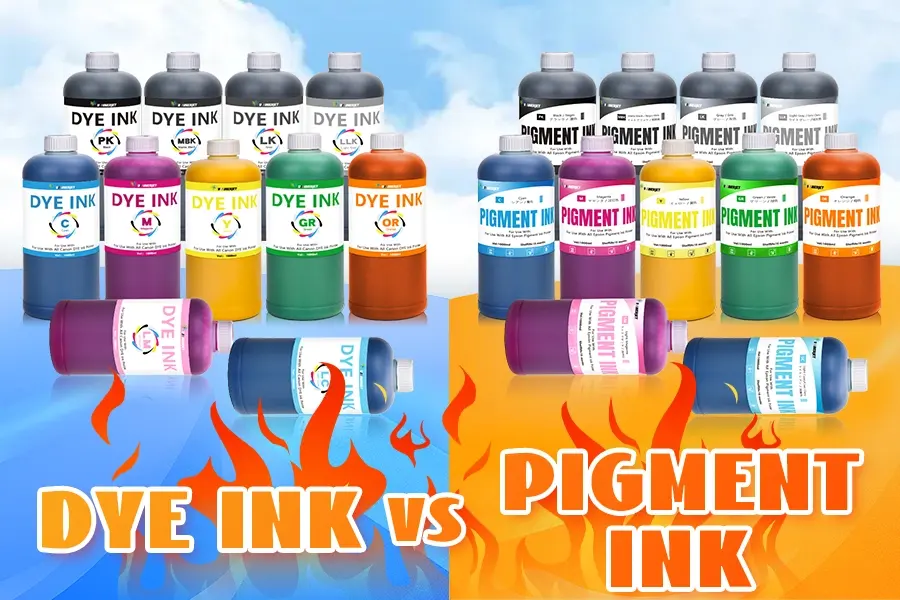
Cost-Effective Ink Solution for Canon PIXMA PRO-100 – Winnerjet
Running an active print studio with the Canon PIXMA PRO-100 quickly highlights the major operational pain point: the high cost of original CLI-42 cartridges. Frequent replacements significantly shrink profit margins for high-volume photo printing, commercial studio proofing, and graphic production. Conversely, switching to unbranded or low-grade market alternatives brings severe risks—poor fluid formulation frequently causes severe color shifts, broken gray balance, and permanent thermal nozzle clogging.
To solve this dilemma, Winnerjet provides premium, factory-direct ink formulations engineered specifically for high-volume commercial needs:
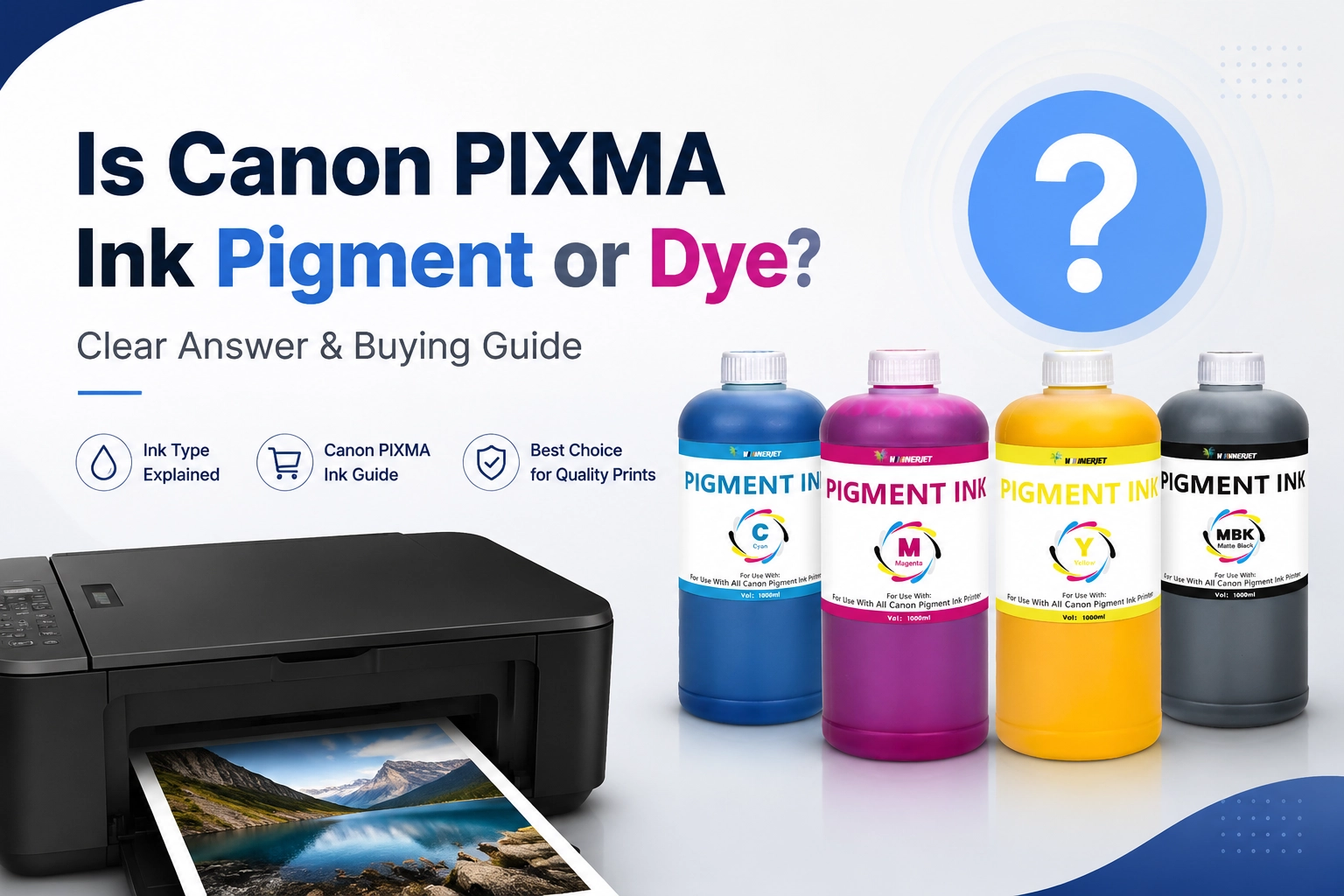
Winnerjet Water-Based Dye Ink Solution: Developed specifically to meet the strict physical parameters of Canon FINE thermal printheads. Our dye ink matches the original CLI-42 ICC color profiles, offering wide color gamuts, rich optical density, smooth grayscales, and zero-clog reliability for continuous print runs.
Winnerjet Pigment Ink Solution: If your business expands into museum-grade archival prints, outdoor graphics, or specialized industrial equipment requiring extreme water and UV resistance, Winnerjet manufactures high-stability pigment ink systems calibrated for dedicated pigment-compatible machinery.
Why Choose Winnerjet: Professional Consumables Manufacturer
- R&D Experience: Decades of chemical formulation experience in custom ink development and printhead tuning.
- Manufacturing Precision: Strict industrial sub-micron filtration ensuring exact viscosity, surface tension, and ICC color matching for Canon and Epson heads.
- Full-Line Authority: One-stop supplier for digital printing—offering DTF powder, DTF film, DTF ink, DTG ink, UV ink, and sublimation consumables globally.
- Factory Wholesale Pricing: Direct-from-factory rates that drastically lower per-page printing costs for studios and print shops.
- Tailored Matching: Technical support to match specific printer models and monthly production performance goals.
As a reminder, the Canon PIXMA PRO-100 is engineered exclusively to run on dye-based ink for peak performance and printhead longevity. Ready to lower your operational costs with factory-calibrated CLI-42 compatible dyes? Contact the Winnerjet Team today for wholesale quotes and testing samples!
FAQS – Canon PIXMA PRO-100 For Dye-Based Inks
Does Canon PIXMA PRO-100 use dye or pigment ink?
The Canon PIXMA PRO-100 uses an 8-color dye-based ink system (CLI-42 series). It is designed for high-gloss photo printing, smooth color saturation, and zero bronzing.
Can I use pigment ink in my Canon PRO-100 printer?
No. The printer’s FINE thermal printhead features 3 pL micro-nozzles calibrated strictly for dye ink viscosity. Loading pigment ink risks permanent nozzle clogging and thermal printhead burnout.
What is the main difference between Canon PRO-100 and PRO-200 ink?
Both use 8-color dye ink systems (CLI-42 vs. CLI-65). The PRO-200 uses an updated dye formula for wider red/blue gamuts, but both printers rely on dye ink for high-gloss media.
Is compatible third-party dye ink safe for Canon PRO-100?
Yes, provided it is high-purity, sub-micron filtered dye ink matched to Canon FINE printhead viscosity. High-grade bulk dye inks deliver OEM-level ICC color accuracy at a fraction of the cost.
How can I lower printing costs on my Canon PIXMA PRO-100?
Switch from single-use OEM cartridges to premium bottled dye ink paired with refillable cartridges or continuous ink supply systems (CISS) to save up to 80% on operational costs.