In an era of short-run branding and rapid customization, food-safe inks for packaging customization have become a critical industry entry barrier. As the market chases personalized bottle stickers and limited-edition labels, printers face a fatal conflict: how to maintain the extreme visual vibrancy of UV printing while ensuring ink components do not “migrate” into the food?
This is not just an aesthetic issue; it is a compliance red line. When handling thin films or high-fat food packaging, standard UV inks often fail rigorous migration testing, becoming a “compliance time bomb” for brand safety.
1. What is Truly Food-Safe UV Ink?
In the world of digital inkjet, true safety is a precision war fought at the molecular level.
Technical Insight: The Risks of Standard UV Ink
Standard UV inks are unsuitable for food packaging due to unreacted chemical residues:
Uncured small molecules can penetrate packaging materials and contaminate food.
Cheap initiators are highly volatile, causing pungent odors and chemical degradation of the product.
Compliance Standards: Your Global Passport
Compliance is the only credential for global distribution. Key standards include:
- FDA (U.S. Food and Drug Administration): Evaluation of Food Contact Substances (FCS).
- EU (EC) No 1935/2004: Materials must not alter food composition or sensory characteristics.
- 2026 German Ink Ordinance (GIO): The world’s strictest standard, enforcing a “Positive List” of ingredients and extreme migration limits.
2026 Industry Alert: As the GIO transition period concludes, food packaging sold in Europe will face “component penetration” spot checks. Upgrading to low-migration solutions now is the best move to avoid future trade barriers.
2. Application Scenarios: Customized Labels & Bottle Stickers
Low-migration UV inks offer unparalleled technical advantages in specific food packaging scenarios:
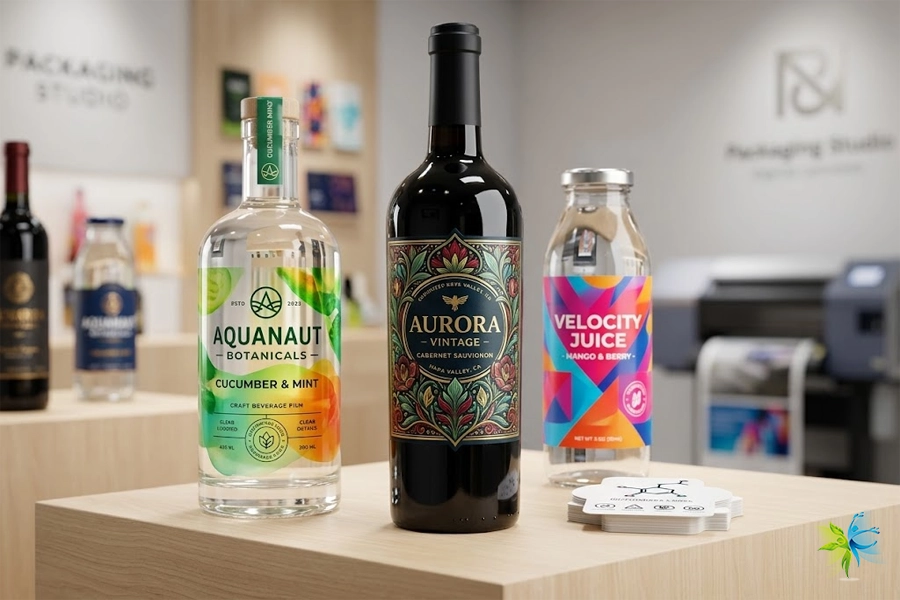
Label Customization: Unlike aqueous inks that struggle with adhesion on PE/PP, UV inks provide superior chemical resistance, staying vibrant even in cold-chain or humid environments.
Bottle Stickers & Cylindrical Printing: Optimized for glass and PET, our formulations use deep-curing technology to eliminate “ink odor” at the source, ensuring a tight bond between the ink layer and the container.
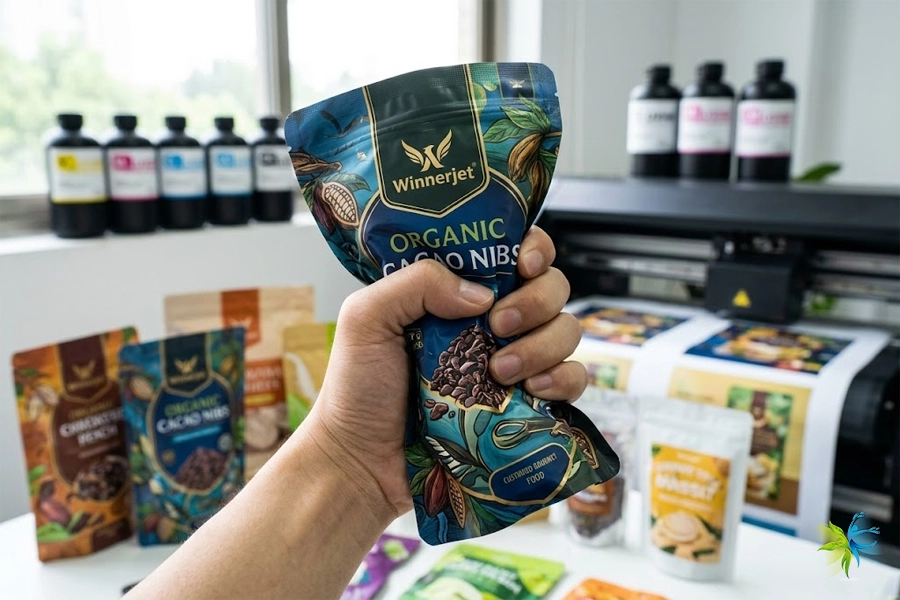
Specialized Digital Printing: For irregular shapes, we support flexible curing solutions. Whether it’s a stand-up pouch or a curved surface, the ink layer extends without cracking or peeling.
Sustainability: De-inking & Recycling
Modern brands demand safety and Recyclability. Our low-migration UV inks are designed with de-inking performance in mind, supporting the efficient separation of labels from PET/PE substrates to help brands meet ESG goals.
Quick Comparison: Which Ink Does Your Project Need?
| Application | Material Type | Recommended Technology | Key Risk Factor |
|---|---|---|---|
| Secondary Cartons | Porous Paper | Aqueous / Eco Inks | Leakage, Dull Colors |
| Bottle Labels | Non-porous Film | Low-Migration UV | Peeling, Odor Residue |
| Shrink Sleeves | PVC / PETG | Flexible Low-Mig UV | Cracking, Migration |
Need a customized ink solution for your specific substrate?
Our R&D team can provide free adhesion and migration compatibility tests for your PET, Glass, or PP materials.
3. Technical Endorsement: On Food Safety
In complex food packaging supply chains, ink stability directly dictates production continuity.
The Balancing Act: High-Speed Curing vs Low Odor
The core challenge of food-grade UV ink lies in the balance: it must cure instantaneously to suit high-speed production lines while remaining completely odorless. The Winnerjet R&D team (built on nearly 20 years of deep industry experience) has overcome this paradox through tens of thousands of formulation tests. By precisely controlling the activity of photoinitiators, we ensure that the ink layer achieves maximum curing purity even under high-speed printing conditions.
Industrial Compatibility: Protecting Your Equipment
Premium low-migration ink must be safe for the consumer and “friendly” to the printhead. Our ink products are deeply optimized for viscosity and surface tension to match mainstream industrial printheads, including Epson, Ricoh, and Kyocera. This high level of compatibility significantly reduces issues like misfiring or clogging, minimizing unplanned downtime and equipment maintenance costs.
Supply Chain Resilience: Global Response for Urgent Needs
Food packaging customization often comes with extremely short delivery cycles, demanding high logistical efficiency.
With nearly 20 years of industry heritage and robust warehousing capabilities, we provide localized rapid response for our overseas clients through strategically placed global warehouses. This not only shortens international lead times but also provides a resilient supply chain support system for brands handling urgent or high-priority orders.
4. Buyer’s Guide: How to Evaluate Your Supplier?
Choosing a supplier is a risk assessment, not just a price comparison.
Confirm these three core points:
- Do they provide an SoC (Statement of Composition)? This is the only written proof of migration risk. Suppliers must declare compliance with EU or German GIO positive lists.
- Have they performed adhesion tests on your specific substrate? Whether it’s matte PET or aluminum foil, the ink must pass cross-hatch or tape-pull tests without compromising safety.
- What is the long-term stability? Low-migration formulas are complex. High-quality inks must remain stable for 6–12 months without separation to avoid clogging expensive printheads.
Conclusion: Safety as a Brand Asset
Choosing Food safe inks for packaging customization is more than a legal requirement; it is an invisible endorsement of brand premium. Safe, odorless, and durable packaging translates directly into high consumer trust.
Ready to upgrade your food labeling solution?