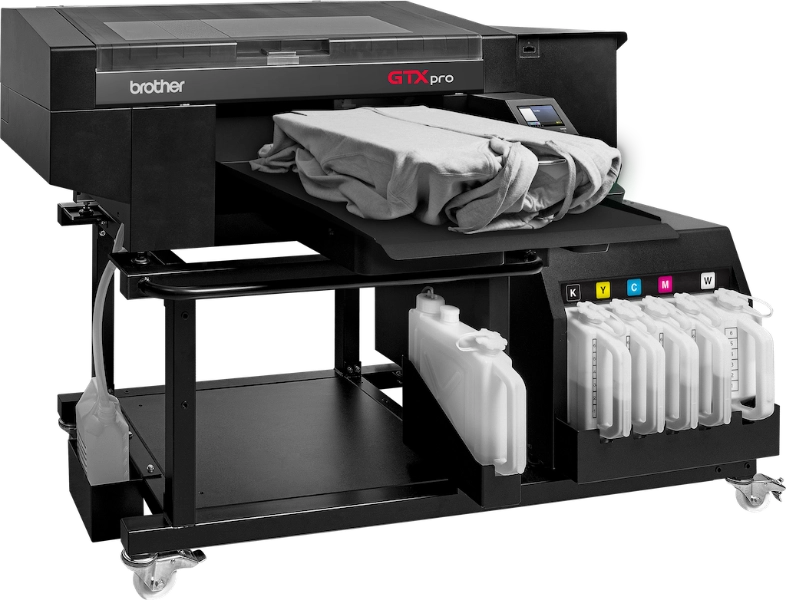
For any DTG print shop owner running a Brother GTX or GTX Pro, the printhead is your ultimate money-maker—and the Brother GTX white ink is your biggest expense.
While original Brother GTX inks deliver beautiful, vivid results, their brand markup is notoriously high, with prices frequently exceeding $500+ per 700cc pouch. Specifically, Brother GTX white ink is typically priced about $20 higher than standard CMYK color cartridges, creating a massive financial burden that directly crushes your profit margins on dark garments.
In this ultimate guide, we will break down the real-world cost per print of Brother GTX white ink, expose the technical physics behind printhead clogging, and reveal how mature textile print shops are safely transitioning to premium, high-tier compatible inks to protect their equipment while restoring profitability.
I. Brother GTX White Ink Cost Per Print
When printing on dark garments, achieving crisp opacity relies entirely on a solid white underbase layer. Because white DTG ink must completely cover dark 100% cotton fibers, its consumption rate is typically 3 to 4 times higher than standard CMYK colors. For commercial workshops, this fluid expense represents your primary production bottleneck.
Based on our data breakdown of official 2026 manufacturer pricing structures, let’s look at the true financial cost:
1. The Financial Drain of OEM Fluid Systems
Legacy Pouch Systems (Brother GTX-422 Era): The official 700ml White Twin-Pack sits at $690.00 CAD, converting to an fluid cost of roughly $0.36 USD per ml. Printing a standard black T-shirt (consuming 8–12ml of white underbase) costs an astonishing $2.88 to $4.32 USD in white ink alone!
Modern Bulk Systems (GTXpro Bulk / GTX600): Although Brother introduced 1.8L industrial bottles and 18L super tubs to reduce running costs, the fluid expenses remain bottlenecked at $0.22 to $0.14 USD per ml.
When facing fierce local competition from traditional screen printing or low-cost commercial DTF setups, these high OEM white ink rates completely freeze your margins and make bidding on large contract orders unsustainable.
| Ink System Type | Fluid Cost Per Milliliter (USD) |
|---|---|
| OEM Standard Pouch System (700ml) | $0.36 USD / ml |
| OEM Industrial Bulk System (1.8L) | $0.22 USD / ml |
| Winnerjet Premium Nano-Grade Ink | $0.05 - $0.09 USD / ml |
| Bottom Line | Cuts your white ink fluid expenses by over 75%! |
2. Doubling Workshop Profits with Premium Compatible Ins
To win high-volume apparel contracts, you must reclaim control of your manufacturing cost structure. By transitioning to a certified, source-factory alternative ink, your operational economics change instantly:
Slashed Fluid Costs: Your raw ink expense drops immediately to just $0.05 – $0.09 USD per ml.
Restored Margins: The white underbase cost for a single shirt plummets from several dollars down to just $0.40 – $1.08 USD. Every time a black t-shirt leaves your dryer conveyor belt, you keep an extra $2.40 to $3.24 USD in pure profit.
3. The “Pre-pay & Lock” Wholesale Program
For established print shops with consistent, predictable monthly production volumes, we offer our specialized “Pre-pay & Lock” bulk contract program. This allows you to freeze factory-direct container pricing for up to 12 consecutive months. No matter how global raw material prices shift or ocean freight rates fluctuate, your production margins remain completely insulated during peak fulfillment seasons.
II. Why Does Brother GTX White Ink Clog So Easily?
In a busy DTG apparel workshop, managing white ink can quickly become a technician’s worst nightmare. Solving frequent nozzle dropouts requires understanding the physical mechanics of why white formulas clog.
1. The Physics of Titanium Dioxide Sedimentation
The Brother GTX utilizes an incredibly sophisticated, high-frequency suspended dual-printhead architecture. To achieve solid white opacity on dark fabrics, the ink formulation relies on high concentrations of heavy titanium dioxide ($TiO_2$) particles.
These mineral micro-particles carry a high physical density, meaning they naturally tend to sink when at rest. Whenever a printer sits idle over a weekend, or if the ink’s chemical suspension properties weaken, gravity causes these heavy solids to settle out of the liquid solution.
As these settling particles accumulate inside the ink lines, dampers, and the micro-nozzles of the printhead, they form microscopic clusters and hard aggregates. This structural sedimentation is the root physical cause behind nozzle deflection, broken nozzle checks, and catastrophic printhead failure.
The Micro-Mechanics of White Ink Clogging
2. The True Hidden Cost of OEM Maintenance Loops
To fight this natural sedimentation, official protocols enforce strict, high-frequency maintenance cycles. Operators must manually remove and vigorously agitate the white cartridges for 30–60 seconds every morning before powering on the equipment.
However, manual shaking cannot clear localized settling deep inside internal fluid channels. As a result, the machine is forced to regularly trigger automated purging and heavy circulation routines.
These aggressive cleaning cycles not only stall your active daily production schedules but also waste a massive volume of expensive ink. Often, shop owners find that hundreds of dollars worth of premium OEM fluid is being pumped directly into the waste tank before a single sellable garment is even printed.
III. How to Choose a Premium Compatible White Ink That Won’t Damage Printheads
While migrating to compatible inks is essential to salvage business margins, the third-party market is highly fragmented. Choosing a low-grade, cheap alternative can easily ruin a thousand-dollar Brother printhead.
As a source factory with nearly two decades of R&D and manufacturing tenure, we collaborated with senior ink formula chemists to define the three mandatory benchmarks you must require from any Brother GTX compatible ink supplier:
1. Triple Nano-Grade Filtration Accuracy
Brother printhead nozzles feature an incredibly tight micro-diameter. Poorly manufactured, cheap aftermarket inks frequently contain particle clusters larger than 0.5$\mu$m, causing instantaneous physical nozzle blockages.
An authentic industrial-grade alternative must undergo a rigorous triple nano-filtration process during manufacturing, locking all suspended solid particles strictly at or below 0.2μm.
This specialized manufacturing control ensures perfect fluid dynamics as the white ink fires through the nozzle plate, eliminating micro-clogging and dropouts at the source.
2. Advanced Macromolecular Anti-Sedimentation Chemistry
Because titanium dioxide is inherently heavy, basic alternative inks show visible separating and bottom-clumping after just a few days of stillness.
High-tier formulations overcome this by blending advanced macromolecular dispersants directly into the fluid batch. These agents form a protective electrostatic barrier around each particle, causing them to repel one another.
This chemical suspension technology keeps the heavy pigments evenly suspended within the liquid solution for extended periods, drastically minimizing daily settling and reducing stress on your floor technicians.
3. Precision Matching of Physicochemical Parameters
Printheads rely on precise electrical firing frequencies, requiring the ink to maintain exact viscosity, surface tension, and rheological performance. Even a slight deviation in fluid characteristics causes ink starvation during high-speed printing.
Premium compatible formulations undergo thousands of hours of rigorous stress-testing to perfectly mirror original OEM baseline characteristics.
Achieving this absolute physical compatibility guarantees that your Brother GTX can run at maximum speed across continuous shifts with zero overspray, zero nozzle deflection, and zero ink starvation.
IV. Fluid Parameter & Cost Comparison: OEM vs. Winnerjet Source Factory
To help your workshop clearly visualize the production advantages, we have compiled a direct evaluation of the primary market options across packaging styles, fluid pricing, and direct savings metrics.
Note: For a comprehensive, multi-dimensional assessment covering precise filtration ratings, white underbase opacity metrics, and wash fastness reports, please refer directly to our specialized 2026 Brother GTX Pro Ink Price & Bulk Savings Guide.
2026 Global Market Brother GTX Pro Fluid Cost Comparison
| Supply Channel / Brand Segment | Packaging Format Style | Fluid Cost Per Milliliter (USD) | Documented Production Margin Savings |
|---|---|---|---|
| Brother OEM Original | 700ml Replacement Pouch | $0.36 USD / ml | Baseline Industry Standard |
| 1.8L Industrial Bulk Bottle | $0.22 USD / ml | ||
| Mainstream Third-Party Retailers (e.g., STS / AA Packs) |
700ml Pouch Alternatives | $0.18 - $0.22 / ml | Saves ~45% - 50% |
| 4L Industrial Gallon Jugs | $0.11 USD / ml | Saves ~50% | |
| Winnerjet Source Factory (Direct Manufacturing Shipping) |
1L Industrial Bottle (CMYK) | $0.026 USD / ml | Saves 90% On Color! |
| 1L Industrial Bottle (White) | $0.033 USD / ml | Saves 85% On White Underbase! |
The data proves that bypassing traditional middleman distributors and sourcing directly from an established manufacturing plant secures a highly competitive wholesale price of $32.90 USD per 1L bottle of premium white ink. This brings your final fluid cost down to an ultra-low $0.033 USD per ml, giving your print shop the absolute pricing power needed to win high-volume, competitive commercial apparel accounts.
V. How to Safely Transition Your Brother GTX to Third-Party Compatible Inks
Switching to alternative inks takes just 20 minutes. Follow this zero-risk, four-step protocol to protect your printheads and ensure a seamless transition:
1. Flush the Lines
Over months of use, older OEM titanium dioxide residues collect inside your ink lines.
Remove the original white cartridges and insert a set loaded with specialized flushing fluid.
Run the machine’s internal line flushing sequence. This clears away all aged ink accumulation and prevents any chemical cross-contamination.
2. Install the New Pouch
Unbox your new 1L industrial bottles or 700ml premium compatible white ink pouches.
Shake the container horizontally and firmly for 30 seconds to fully activate the suspension agents.
Insert the container into the Brother GTX slots. The cartridge fit and microchip signals perfectly match OEM specifications for instant recognition.
3. Initial Charge
Access your maintenance control panel and run 2 cycles of the Initial Charge or deep priming routine.
This draws the fresh triple nano-filtered ($\le$ 0.2$\mu$m) white ink through the lines, completely replacing the flushing fluid and priming the nozzles for production.
4. Test & Verify
Before starting full production runs, execute two quick quality checks:
Nozzle Check: Print a test pattern onto a clear film sheet. A clean, complete grid line means your printhead is perfectly primed with zero dropouts.
Stretch & Opacity Test: Print a solid white block onto a black cotton garment. Confirm the white underbase looks thick and bright. Once cured, stretch the fabric firmly—the print must flex easily without any cracking, maintaining a solid 4.5+ wash fastness rating.
By choosing a triple nano-filtered alternative ink, modern print shops successfully unlock massive financial freedom without sacrificing image vibrancy, wash performance, or printhead safety.
📉 Are High OEM Fluid Costs Bottlenecking Your Shop’s Growth?
Connect directly with our on-floor technical engineers today. Request a Free 1000ml Technical Testing Sample and let us build a customized production ROI breakdown tailored specifically to your workshop’s monthly volume!