In the digital printing industry, clogged printheads and batch-to-batch color inconsistency are two major pain points caused by substandard production processes. To avoid these pitfalls, it is crucial to understand the underlying logic of how ink is manufactured.
As a professional team with nearly 20 years of expertise in ink R&D, we know that stable quality stems from rigorous process control. This article provides an in-depth look at the three core stages of the Inkjet Ink Manufacturing Process: from high-standard raw material selection and nano-scale grinding to the final three-stage high-precision filtration. Here is how a high-quality drop of ink is born.
I. Raw Material Selection: The Foundation of Quality
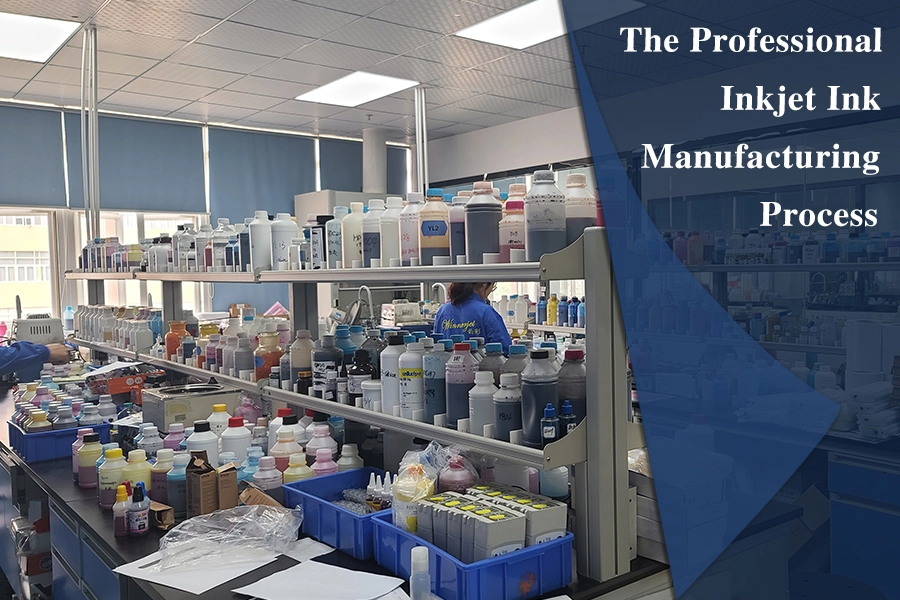
The life of a premium inkjet ink begins with a nearly obsessive selection of High-purity raw materials. Throughout two decades of industry observation, we have found that raw material purity and chemical stability are the fundamental factors determining final print saturation and printhead longevity.
1. Core Components: Pigments vs Dyes
At the start of the manufacturing process, the appropriate color carrier must be selected based on the application:
Pigment: Widely used in DTF, DTG, and UV printing. High-quality pigment inks require advanced Pigment dispersion technology. We select pigments with an extremely narrow particle size distribution to ensure superior weather resistance and wash fastness.
Dye: Primarily used for sublimation printing, focusing on molecular-level solubility and a brilliant, wide color gamut.
2. The Inkjet Ink Chemical Formula Checklist
To synthesize a stable ink, a precise ratio of the following core raw materials is required:
Deionized/Ultra-pure Water: The primary solvent for inkjet ink. All metal ions must be removed to prevent abnormal conductivity or impurity crystallization that could clog nozzles.
Humectants: Such as Glycerin or Polyethylene Glycol (PEG). These reduce the evaporation rate of the solvent, preventing the ink from drying and clogging at the nozzle.
Co-solvents: Usually organic solvents are used to regulate the penetration and drying speed of the ink.
Surfactants: Used to adjust the Surface Tension, ensuring the ink droplets spread correctly or maintain controlled diffusion on the substrate.
pH Buffers: Such as Triethanolamine, used to maintain the acid-base balance and prevent the ink from corroding the metal components inside the printhead.
Biocides/Fungicides: These prevent the growth of bacteria or fungi during storage, which could otherwise lead to organic degradation.
3. Additives: The Invisible “Moat” of Stability
In addition to the basic ingredients mentioned above, inks for specific machines (such as Epson, Ricoh, or Kyocera printheads) include specialized Additives. These trace elements significantly improve physical performance, ensuring the ink remains consistent in chemical properties even under extreme temperatures or long standby periods.
II. Core Manufacturing Steps: From Mixing to Nanotechnology
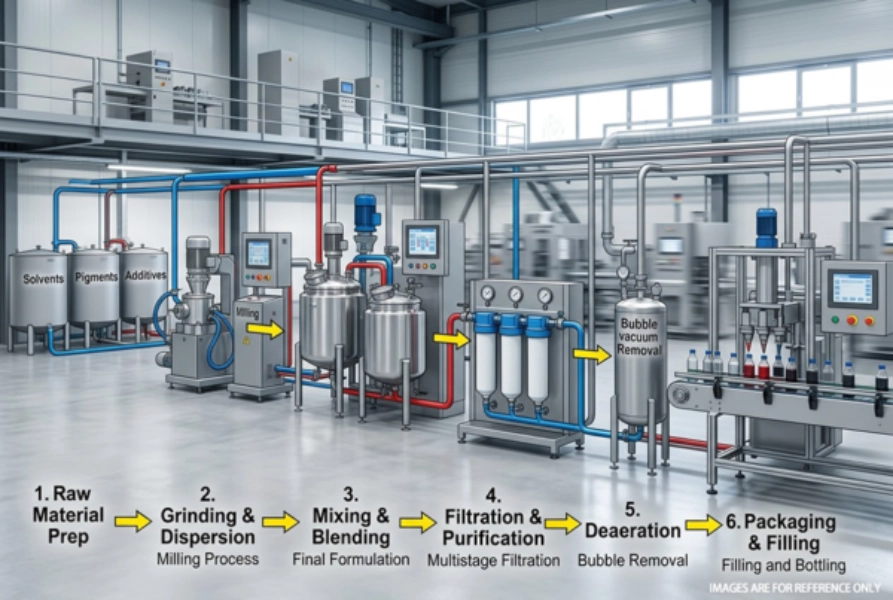
If raw materials are the “DNA” of the ink, the manufacturing process is its “skeleton.” High-performance inkjet ink production is not a simple mixing task; it is a precisely controlled physical and chemical reaction.
1. Premixing Stage: Building a Stable Dispersion System
Before formal grinding, Premixing must take place. The goal of this step is to pre-blend solid pigment powder, resins (binders), and partial solvents into a fluid slurry.
High-Speed Shearing: Using a High-speed Dissolver, powerful mechanical shear force breaks down initial clusters of pigment particles.
Wetting Process: This ensures the surface of every pigment particle is completely “wetted” by the resin and solvent. If premixing is insufficient, grinding efficiency will drop significantly, potentially leading to ink stratification (layering).
2. Nano-Grinding Technology: The Key to Preventing Clogs
This is the most technical stage of the inkjet ink manufacturing process and the hallmark of professional expertise. Because printhead nozzles are extremely small, even the tiniest particle clusters can cause catastrophic clogs.
Zirconium Beads Milling: To achieve ultimate fineness, professional plants use high-energy bead mills. The grinding chamber is filled with tiny, high-purity Zirconium beads. Under high-speed rotation, these beads collide and rub at high frequencies to pulverize pigment particles.
Technical Parameter (100nm – 200nm): An elite grinding process controls the particle size precisely between 100nm and 200nm.
Why this range? If particles exceed 200nm, the risk of sedimentation increases exponentially, leading to clogs.
If particles are kept at the nano-scale with a uniform, narrow distribution, the ink achieves excellent fluidity and reflects more vivid, pure colors.
III. Filtration and Purification: Ensuring “Absolute Purity”
Even after high-energy grinding, trace amounts of uncrushed clusters or tiny impurities may remain. To ensure long-term nozzle operation, a rigorous physical defense must be established.
1. Three-Stage Filtration: Progressive Precision Control
In a modern inkjet ink manufacturing process, filtration is a multi-stage, gradient system designed to balance efficiency with filter longevity:
Stage 1: 5μm Coarse Filtration: Primarily used to intercept micro-debris from the grinding media or larger pigment clusters, protecting the more precise filters in the next stages.
Stage 2: 1μm Fine Filtration: This stage captures invisible impurities that are still large enough to interfere with jetting stability. It is the key to smooth ink flow through the supply lines.
Stage 3: 0.2μm Absolute Filtration: The final gatekeeper. Using polymer membranes (like PP or PES), this stage limits particle size to an extremely fine range, ensuring every drop of ink reaches “electronic-grade” purity.
2. Why is 0.2-Micron Filtration Critical for High-End Inks?
For DTG, DTF, and UV inks, 0.2μm precision is the standard of performance:
Printhead Protection: Modern industrial printheads (like Epson i3200 or Ricoh G6) have nozzle diameters around 20μm, but their internal channels are highly sensitive. A 0.2μm standard ensures particles are far smaller than the nozzle, eliminating physical clogging risks.
UV Ink Stability: UV inks contain photoinitiators and monomers; 0.2μm filtration removes micro-gel particles, preventing premature physical polymerization.
Optimizing White Ink: In DTF and DTG printing, white ink contains high-density Titanium Dioxide. Fine filtration ensures the white ink stays suspended in the circulation system, reducing maintenance issues caused by settling.
IV. Quality Assurance (QA): Multi-Dimensional Testing
In high-performance ink production, Quality Assurance is the bridge between manufacturing and application. By monitoring the following core technical indicators, we ensure compatibility across different printhead brands.
1. Viscosity & Surface Tension: The Foundation of Accuracy
These physical properties determine whether a droplet lands precisely on the substrate:
Viscosity: This affects the flow rate and replenishment speed in the supply system. If viscosity deviates, it leads to waveform mismatch, causing “satellite” drops or ink starvation.
Surface Tension: This determines the shape of the droplet at the nozzle and its spread on the media. Precise control ensures a perfect spherical drop for sharp, crisp image edges.
2. pH Value Stability: Extending Printhead Life
The internal structure of an inkjet printer is delicate, containing complex metal components and adhesives:
Chemical Compatibility: Ink must stay within a specific pH range (usually slightly alkaline or neutral). Unstable pH can trigger chemical corrosion, damaging the piezo crystals or internal channels.
Long-term Stability: Professional testing includes accelerated aging to ensure the pH remains in the safety zone for months or years, which is vital for bulk storage.
3. Climate Simulation: Global Market Adaptability
Premium ink must resist environmental interference. We simulate extreme global climates:
High-Temperature Aging: Testing for chemical stability and sedimentation in heat, ensuring reliability in tropical regions.
Freeze-Thaw Testing: Simulating shipping environments in cold climates. High-quality ink must recover its full physical and chemical properties after thawing without irreversible crystallization.
Intermittent Jetting Test: Simulating real-world usage to test how smoothly the ink restarts after long periods of downtime.
V. Why Choose a Professional Ink Factory?
After exploring the complex inkjet ink manufacturing process, the conclusion is clear: high-quality ink is not just a chemical mix; it is the result of advanced equipment, rigorous processes, and deep industry experience.
Choosing a capable bulk ink factory offers your business several core values:
- High ROI: While premium ink may have a higher initial cost, it significantly increases profitability by reducing printhead replacements, maintenance downtime, and bulk return risks.
- Continuous Batch Consistency: A professional ink manufacturing plant uses standardized processes and automated controls. This ensures the ink you receive today is identical in color and performance to what you received a year ago, protecting your brand reputation.
- R&D for Cutting-Edge Technology: As technology shifts toward DTF, DTG, and high-end UV, only factories that invest in R&D can keep pace with new printhead updates (like thin-film piezo technology) and provide competitive solutions.
VI. The Difference Between Industrial and Office Inkjet Ink Production
Although these two types of ink may appear similar, their production requirements differ vastly. Understanding these differences is crucial for selecting the appropriate ink for specific printheads and substrates.
Industrial vs Office Inkjet Ink Production
| Feature | Office Inkjet Ink (Consumer) | Industrial Inkjet Ink (Commercial) |
|---|---|---|
| Durability | Standard (indoor use) | High (UV, water, and scratch resistance) |
| Particle Size | Typically larger (microns) | Ultra-fine (sub-micron / nanoscale) |
| Filtration Level | Single or double-stage | Multi-stage nano-filtration |
| Batch Consistency | Moderate | Extreme (Zero tolerance for color shift) |
| Common Substrates | Paper, photo paper | Plastic, metal, glass, textiles, ceramic |
VII. Global Premium Ink Brand Reference
When searching for a reliable ink manufacturing plant, understanding the industry leaders helps establish a quality benchmark. The following brands represent different pinnacles of manufacturing:
OEM Brands: Such as Epson, Canon, HP, and Roland. They offer perfect ink-to-printhead matching at the highest cost.
International Third-Party Specialists:
Nazdar (USA): World-renowned for high-quality UV and outdoor solvent inks.
Marabu (Germany): Holds deep technical patents in industrial and screen printing inks.
Sensient (USA): Focused on precise color management and high-performance chemical development.
Winnerjet (China): With nearly 20 years of manufacturing experience, Winnerjet has achieved a 1:1 restoration effect comparable to original inks for DTF, DTG, and UV applications. Winnerjet’s core strength lies in applying rigorous 3-stage filtration and nano-grinding to large-scale production.
OEM/ODM Customization: Unlike traditional brands, Winnerjet offers flexible OEM solutions. From custom color formulations to private labeling, we provide one-stop manufacturing support from R&D to finished product, serving as a silent partner for many international brands.
Conclusion: Beyond Color, Driving Value
The birth of every drop of ink is a pursuit of extreme precision. Every step—from raw material selection to nano-grinding and final filtration—impacts your production efficiency and final quality.
If you are looking for a partner to provide stable performance, protect your hardware investment, and grow your business, understanding the manufacturing process is the first step.
Want to learn more about Winnerjet’s technical standards or request a custom sample for your equipment?