Choosing absolute eco-friendliness used to mean sacrificing media versatility and outdoor lifespan. Historically, you simply couldn’t have both.
Now, water-based eco-solvent ink is changing the game. By blending a clean water carrier with tough, weather-resistant resins, this innovation promises premium outdoor performance with zero toxic compromise.
But can a water-based formulation truly match a time-tested solvent ink when exposed to the elements? Let’s break down the outdoor metrics, printhead safety, and real-world costs.
1. Understanding the Core Difference
While both technologies strive for excellent color expression, their underlying carrier chemical formulations directly determine their environmental profile and machine maintenance overhead.
What Is Traditional Eco-Solvent Ink?
Traditional eco-solvent ink relies on petrochemical solvents as the primary vehicle carrier for pigment particles.
Working Principle: The organic solvents slightly “dissolve” or penetrate the surface of uncoated substrates (like PVC vinyl), embedding pigments deeply into the material before evaporating under heat.
Characteristics: This creates rugged outdoor adhesion, heavy scratch resistance, and waterproof reliability. However, the evaporation releases mild volatile organic compounds (VOCs) and a distinct chemical odor, requiring active workshop ventilation.
What Is Water-Based Eco-Solvent Ink?
Water-based eco-solvent ink reformulates this completely by using high-purity water as the primary carrier, fused with modified eco-solvent resins.
Working Principle: It utilizes water as a dispersing vehicle. Under the printer’s heating system, the water rapidly evaporates, causing the polymer resins to undergo cross-linking. This forms a dense, waterproof protective layer on the media surface.
Characteristics: This technology cuts off the source of harmful VOC emissions, making it almost entirely odorless. Thanks to advanced resin evolution, it bonds onto uncoated outdoor substrates without requiring specialized pre-treatments.
2.Comparison: Outdoor Performance Metrics
For print operators, any green innovation is non-viable if it loses its commercial lifespan under the elements.
UV Resistance & Anti-Fading
Traditional Eco-Solvent: Highly resilient against solar UV rays. Without lamination, prints typically last 2 to 3 years outdoors before noticeable fading occurs.
Water-Based Eco-Solvent: Utilizes highly weather-resistant nano-scale pigments. Without lamination, its outdoor anti-fading lifespan reaches 1.5 to 2 years. While slightly lower than solvent ink, it fully satisfies short-to-medium-term outdoor sign applications.
Waterproof & Scratch Resistance
Unlaminated: Traditional eco-solvent “bites” into the media, yielding excellent raw scratch resistance. Water-based eco-solvent is completely waterproof once dry, but its raw ink layer is slightly more delicate against heavy physical scraping before film application.
Laminated: Once a standard cold lamination film is applied, the physical scratch resistance and weatherproofing of both inks become completely equalized, meeting industrial outdoor tear standards.
Media Compatibility
PVC Vinyl & Flex Banner: Traditional eco-solvent offers maximum adhesion on cheap or heavily plasticized substrates. Water-based eco-solvent delivers excellent adhesion on premium PVC vinyl, though it may show reduced saturation on oily, low-grade banners.
Canvas & Fine Art Media: Water-based eco-solvent surpasses traditional solvents here. It avoids excessive solvent bleeding, resulting in sharper dots, smoother gradients, and zero chemical odor on indoor-displayed art.
📊 Direct Comparison Table
| Core Evaluation Metrics | Traditional Eco-Solvent Ink | Water-Based Eco-Solvent Ink | Winner / Decision Reference |
|---|---|---|---|
| Outdoor UV Lifespan (Unlaminated) | 2 - 3 Years | 1.5 - 2 Years | Traditional Eco-Solvent (Longer raw life) |
| Waterproof & Scratch (Unlaminated) | Robust raw ink scratch resistance | Flawless waterproof; moderate scratch | Traditional Eco-Solvent (Equalized after lamination) |
| Dry Speed | Fast (relies on fast solvent evaporation) | Moderate (requires stable machine heating) | Traditional Eco-Solvent (Slightly faster throughput) |
| Odor Level | Noticeable chemical odor | Almost completely odorless | Water-Based Eco-Solvent (Perfect for indoor/malls) |
| Color Saturation & Sharpness | Rich and bold; minor bleeding at high resolutions | Ultra-fine detail, sharp dots, zero bleed | Water-Based Eco-Solvent (Superior photo precision) |
| Uncoated Media Compatibility | Universally wide (PVC, vinyl, banner, leather) | Wide (compatible with PVC, vinyl, wallpaper, canvas) | Traditional Eco-Solvent (Better on low-grade stocks) |
💡 Which is better for outdoor?
Traditional eco-solvent ink is better for: Long-term, high-exposure commercial outdoor billboards, permanent fleet wraps, and high-volume facilities prioritizing maximum print speeds and lowest raw material costs.
Water-based eco-solvent ink is better for: Short-to-medium-term outdoor graphics, custom apparel heat transfers on desktop setups, premium wallpaper murals, and print shops operating under strict indoor environmental compliance rules.

3. The Green Revolution: Environmental Compliance & Safety
With global VOC emission laws tightening, eco-friendliness determines market entry. Water-based technology offers a profound advantage for print shops targeting premium or high-compliance commercial spaces.
Odorless Working Environment
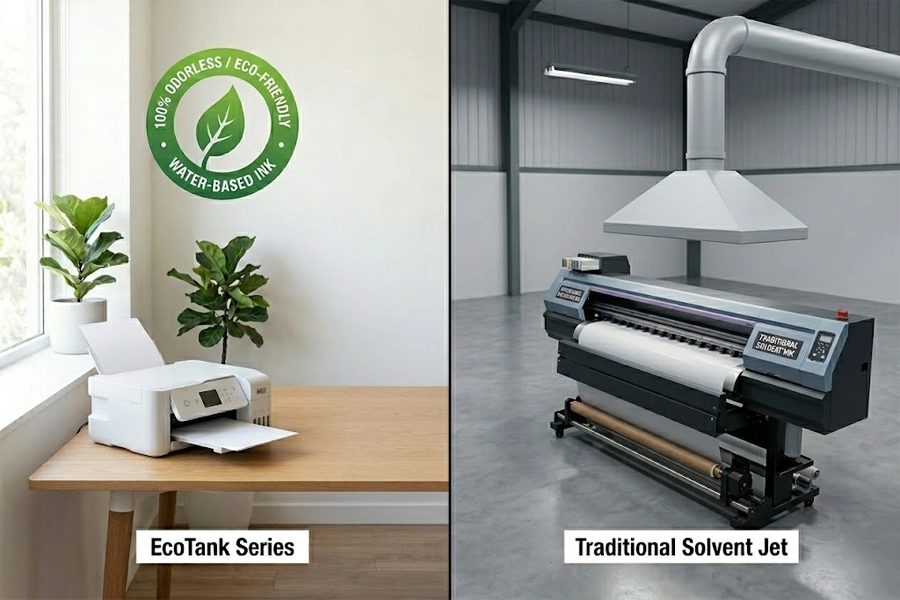
Traditional eco-solvent inks release organic vapors during heating. Working long hours without heavy-duty ventilation can cause operator fatigue or respiratory discomfort. Water-based eco-solvent ink replaces harsh chemical vectors with water, rendering production virtually odorless. It eliminates the need for expensive industrial exhaust ducting, making it perfect for office units, malls, or home studios.
International Certifications
To win premium corporate contracts or cross-border B2B export orders, print safety must be verifiable. High-tier water-based formulations carry verified international safety compliance:
OEKO-TEX® Standard 100: Certifies that the cured ink contains zero harmful substances, rendering heat transfers completely safe for prolonged skin contact, including infant apparel.
EU REACH Compliance: Guarantees the formulation is completely free of Substances of Very High Concern (SVHC), protecting your goods from customs delays in the European market.
RoHS Directive: Mandates zero heavy metal toxins (such as lead, mercury, or cadmium), making it ideal for eco-certified packaging.
4. Printhead Compatibility & Maintenance Costs
Printheads are an expensive consumable asset. For many buyers, the core concern is hardware longevity and avoiding catastrophic clogging issues.
Does it Corrode Printheads?
Traditional eco-solvent inks carry chemical properties that can degrade plastics, rubber seals, and internal adhesives over time. Running standard solvent inks through an unmodified consumer desktop unit will quickly dissolve internal channels.
Conversely, eco solvent water based ink uses water as its primary vehicle agent, yielding zero chemical corrosiveness toward printhead components. It is exceptionally gentle on micro-piezoelectric configurations, maximizing the working life of industrial printheads (like the Epson I3200-A1) and desktop lines alike.
Machine Adaptation
Desktop Conversion (e.g., Epson EcoTank Series): This ink serves as a turnkey solution. Because it is non-corrosive and filtered down to a tight sub-micron profile (0.2μm), you can fill standard EcoTank reservoirs directly without replacing lines or upgrading to solvent-resistant dampers.
Wide-Format Commercial Printers: No major hardware rebuild is required. Because water demands a slightly higher latent heat to vaporize compared to volatile solvents, operators simply need to increase built-in pre- and post-heating stage panel settings by 3°C to 5°C to ensure thorough cross-linking.
🛠️ Maintenance Rule: Because both ink families rely on resin cross-linking to achieve water resistance, you must never mix them. Always perform a comprehensive flush using a designated water-based eco-solvent cleaning flush when migrating systems to prevent internal resin coagulation.
5. Summary Judgment: Which One Should You Choose?
📌 Choose Traditional Eco-Solvent if…
Your core business relies on long-term outdoor billboards or commercial fleet wraps requiring a 3+ year unlaminated lifespan.
You possess a dedicated industrial space with heavy-duty exterior exhaust ventilation.
Your primary market focuses on mass-volume, ultra-low-cost production.
📌 Choose Water-Based Eco-Solvent if…
You focus on custom apparel heat transfers, labels, or stickers using desktop eco-tank systems.
You print in enclosed settings (shopping centers, office suites, homes) requiring a completely odorless workspace.
You serve premium corporate accounts or export printed goods to Western markets demanding strict OEKO-TEX, REACH, or RoHS safety compliance.
FAQ Eco-Solvent Ink
Can I use water-based eco-solvent ink directly in a standard Epson EcoTank printer?
How long can it last outdoors without lamination?
Is it safe for garment printing and heat transfers?
Do I need to modify my printer's heating array?
Can I mix it with traditional eco-solvent or standard pigment inks?
7. Partner with a Leading Ink Manufacturer
Are you looking to upgrade your product line or lower your printing costs with premium water-based eco-solvent ink? Partner directly with a trusted source factory in China to maximize your profit margins and secure a competitive edge in your local market.
✅Wholesale Factory Pricing
✅Flexible MOQ & Customization
✅Free Sample Testing
👉 Contact Our Engineering Team Today!
Ready to switch to eco-friendly, compliant, and high-margin printing? Click below to request a wholesale price list or talk to our lead consultants about your custom formulation needs.